Grocery Know-How
Bottle Service: What Olive-Oil Grades Actually Say
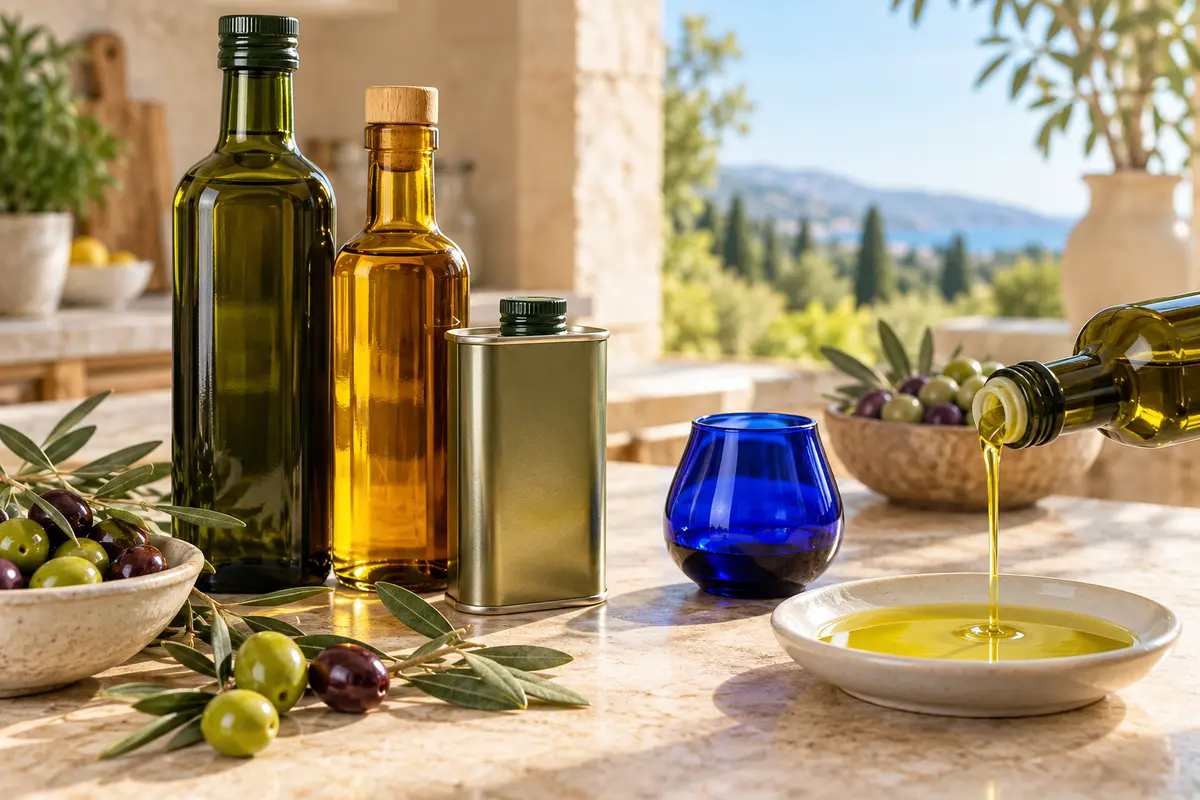
Extra virgin, virgin, olive oil and pomace oil are not just marketing poetry. Each name points to a different route from fruit to bottle—and a different set of tests.
The olive-oil shelf can look like a tiny awards ceremony: extra virgin, virgin, pure, classic, light-tasting, cold pressed. The useful clue is that some of those words are regulated grades, while others are descriptive language. In Canada, the grade line is the best place to begin because it tells you more about how the oil was made and assessed than the pastoral picture on the front.
Start with the virgin family. The International Olive Council defines virgin olive oils as oils obtained from olives only by mechanical or other physical means, without treatments beyond washing, decanting, centrifuging and filtering. Extra virgin and virgin olive oil both belong to that family. The difference is not simply that one was pressed with extra enthusiasm; each category must meet its own chemical and sensory limits.
One of those limits is free acidity. Under the IOC standard, extra virgin olive oil may contain no more than 0.8 grams of free acidity, expressed as oleic acid, per 100 grams. Virgin olive oil may contain up to 2 grams per 100 grams. Despite the familiar word, this is not the sharpness you taste in lemon juice or vinegar. It is a laboratory measure of free fatty acids and does not directly describe whether the oil tastes sour.
Chemistry is only half the audition. Virgin oils are also assessed for aroma and flavour. Extra virgin oil must satisfy the sensory requirements for its category, not merely slip under an acidity number. The IOC maintains standardized methods for trained tasting panels, including controlled glassware and serving temperature. That is why a bottle cannot earn its grade from colour or a single lab figure alone.
Now meet the label that simply says ‘olive oil.’ In IOC terminology, that product is a blend of refined olive oil and virgin olive oils fit for consumption. Refining removes unwanted characteristics from lower-grade virgin oil; blending some virgin oil back in returns flavour. It is still olive oil, but it has travelled a different production route from extra virgin. ‘Olive pomace oil’ is another distinct category made from the solid olive residue left after the first extraction, then refined and blended according to its standard.
Canadian guidance follows these distinctions. The Canadian Food Inspection Agency says products sold as extra virgin or virgin olive oil must meet the relevant IOC and Codex definitions, and a product represented as olive oil cannot be padded with another kind of oil. CFIA also warned industry in April 2025 that declared quality must remain accurate through the product’s shelf life, because light, temperature and time can degrade virgin oil.
That brings the bottle itself into the decision. UC Davis food-quality guidance notes that dark or opaque packaging slows the light exposure that hastens oxidation, while limiting oxygen also helps preserve quality. A harvest date, when supplied, gives useful freshness context; a best-before date tells a different story because it is set from packaging and shelf-life assumptions. Neither date replaces your nose once the bottle is open.
A calm shopping routine needs only four checks. First, read the exact grade rather than the biggest adjective. Second, choose a bottle size you can finish while it still smells fresh. Third, favour packaging that blocks light and store it in a cool, dark cupboard away from the stove. Fourth, match flavour to the job: a lively extra virgin can be the point of a dressing or finishing drizzle, while a milder refined-and-virgin blend may suit a dish where the oil should stay in the background.
Olive-oil labels are less mysterious once you treat them as a short production biography. ‘Extra virgin’ describes a mechanical route plus chemical and sensory performance. ‘Olive oil’ signals a refined-and-virgin blend. ‘Pomace’ names a separate starting material. Read the grade, protect the bottle, and let your own nose decide whether the ending is still fresh.
Sources
- https://www.internationaloliveoil.org/olive-world/olive-oil/
- https://www.internationaloliveoil.org/what-we-do/chemistry-standardisation-unit/standards-and-methods/
- https://inspection.canada.ca/en/food-labels/labelling/industry/fats-and-oils
- https://inspection.canada.ca/en/food-labels/labelling/industry/fats-and-oils/notice-industry-2025-04-24
- https://ucfoodquality.ucdavis.edu/olive-oil/olive-oil-packaging
You may also like these