Food Technology
Squeeze Play: How High Pressure Keeps Some Dips Chilled
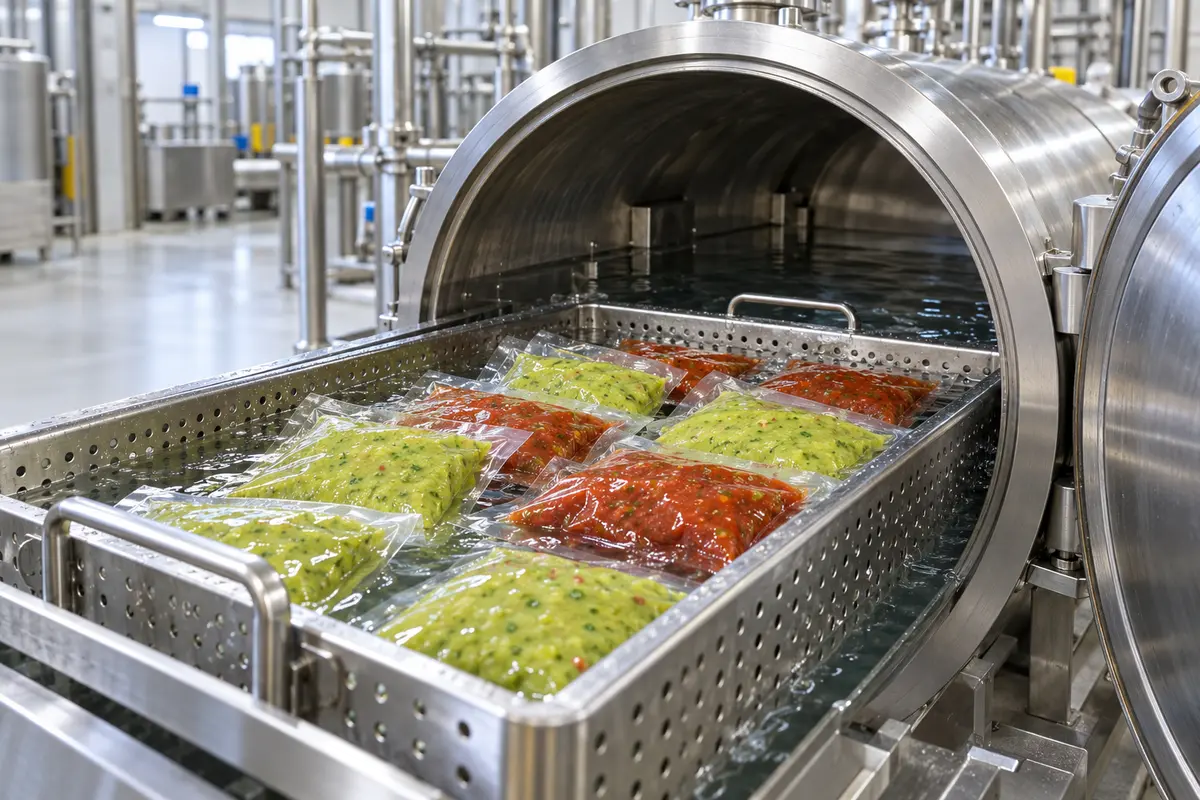
Some refrigerated guacamole, salsa and juice take a short trip into an enormous water-powered press. The package stays sealed; pressure does the preservation work.
Picture a sealed pouch of guacamole entering a steel vessel rather than a hot-water bath. The chamber fills with water, pumps raise the pressure dramatically, and a few minutes later the still-sealed pouch comes back out. That is high-pressure processing, usually shortened to HPP.
The Canadian Food Inspection Agency describes HPP as a non-thermal preservation method. Solid or liquid food sits in a pressure vessel while a pressure-transmitting medium—usually water—surrounds it. Commercial treatments commonly reach about 600 megapascals, or 87,000 pounds per square inch, for one to five minutes. That is close to six thousand times ordinary atmospheric pressure.
The key trick is uniform pressure. Water carries the force throughout the package from every direction, so a flexible pouch compresses and rebounds instead of being flattened like a sandwich under a book. The packaging still has to be designed and validated for the process; a rigid jar with no room to flex is not an automatic candidate.
At those pressures, many vegetative microorganisms can be inactivated and some enzymes can be slowed. HPP is often used to reduce pathogens or spoilage organisms and extend refrigerated shelf life. It is not a universal sterilizer, though. The food's acidity, composition and temperature, along with the target organism, pressure and holding time, all affect the result. Producers must validate the treatment for the specific food and safety job.
Why use pressure instead of simply adding more heat? Near room temperature, pressure tends to leave many small flavour, colour and aroma molecules less altered than an intense thermal treatment would. That helps explain why HPP is attractive for foods sold on a fresh-tasting identity, including juices, fruit preparations, salsa and guacamole. Less heat does not mean zero change: fragile plant cells can soften, proteins can shift, and pressure-sensitive enzymes may behave differently from one recipe to another.
Health Canada's published example for packaged avocado pulp, guacamole and tomato salsa uses 600 megapascals for three minutes at ambient temperature. In a 2024 study, avocado purée treated at the same pressure and time remained microbiologically stable during 28 days of refrigerated storage, while the untreated comparison deteriorated sooner. That result belongs to that formulation and study—not every green dip—but it shows why processors test pressure, time, recipe and cold storage as one system.
There is also a useful label distinction. 'Cold-pressed' usually describes how juice was extracted. HPP describes a later preservation step and is sometimes marketed as 'cold pressure.' One does not guarantee the other. If the package says high-pressure processed, it tells you about the preservation route, not that the product is raw, shelf-stable or free from every microbe.
The home-kitchen rule stays wonderfully ordinary: keep refrigerated HPP foods cold, respect the date and storage directions, and refrigerate promptly after opening. Pressure can buy a sealed product more time, but it does not cancel the cold chain or turn an open tub into a pantry item.
HPP is impressive because the drama happens without opening the package. Water delivers a brief, enormous squeeze; microorganisms take the hit; and the dip keeps much of the colour and character shoppers expect. The machine may be extraordinary, but the final instruction is familiar: back into the fridge.
Sources
- https://inspection.canada.ca/en/preventive-controls/high-pressure-processing
- https://www.canada.ca/en/health-canada/services/food-nutrition/legislation-guidelines/guidance-documents/position-high-pressure-processing-no-longer-novel-process-treated-food-products-treated-food-products-2013.html
- https://www.canada.ca/en/health-canada/services/food-nutrition/genetically-modified-foods-other-novel-foods/approved-products/novel-food-information-avocado-pulp-tomato-based-salsas-guacamole-treated-high-pressure-processing.html
- https://www.fda.gov/files/food/published/Kinetics-of-Microbial-Inactivation-for-Alternative-Food-Processing-Technologies.pdf
- https://pubmed.ncbi.nlm.nih.gov/38086753/
- https://link.springer.com/article/10.1186/s43014-024-00245-5
You may also like these