Food Technology
Cold Case Files: The Label That Remembers Every Warm Spell
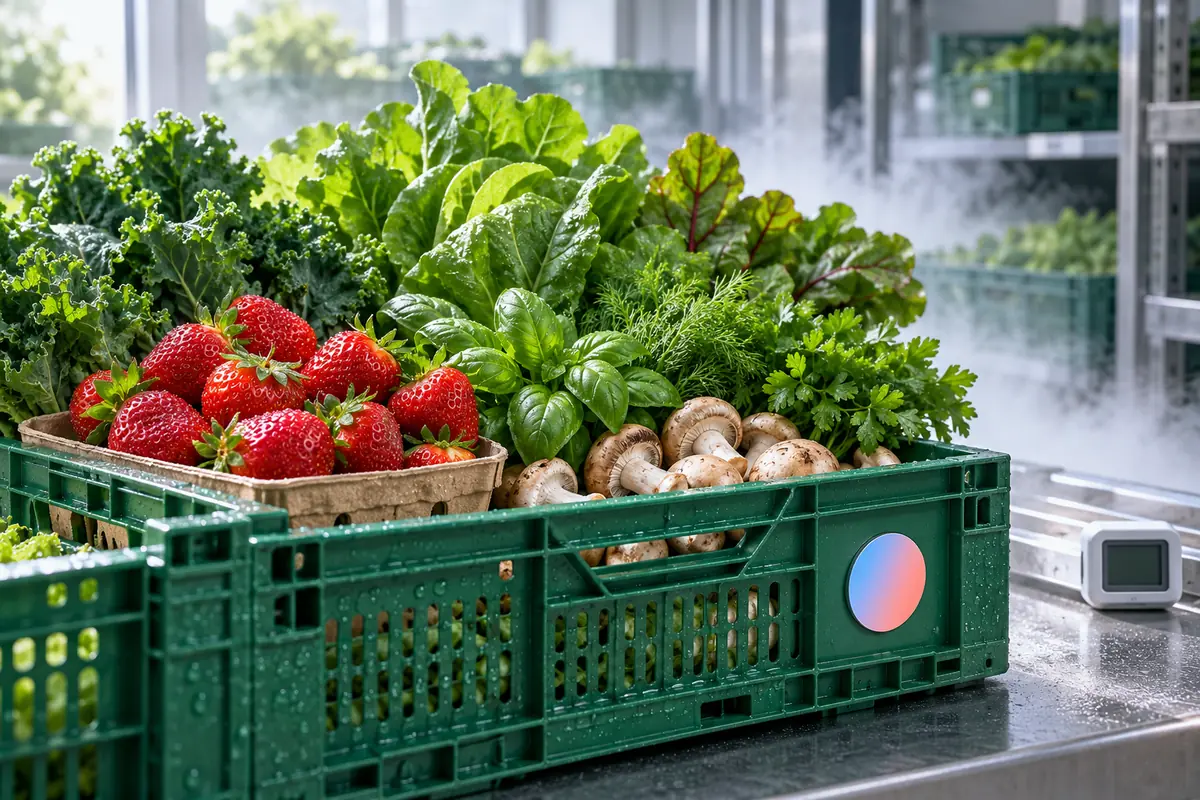
A thermometer reports the temperature now. A time-temperature indicator can remember the journey, turning accumulated warmth into a visible clue about a perishable food's history.
A thermometer can tell you that a crate of strawberries is cold right now. It cannot tell you whether that crate spent three warm hours on a loading dock yesterday. For that, the cold chain needs a memory. One compact answer is the time-temperature indicator, or TTI: a label designed to respond to both how warm a product became and how long it stayed that way.
The idea matters because temperature does not affect food quality like a simple on-off switch. Many chemical, enzymatic and microbial processes speed up as conditions get warmer. A brief temperature rise and a long one may therefore have very different consequences, even if both foods are equally cool when someone finally checks them.
A TTI turns that history into a visible change. Depending on its design, a dye may move, a coloured area may grow, or a patch may shift shade as a physical, chemical, enzymatic or biological process advances. The reaction is usually irreversible, so cooling the package again does not reset the evidence. Think of it less as a tiny thermometer and more as a stopwatch whose pace changes with temperature.
That colourful simplicity hides serious calibration work. The indicator's response has to match the way a particular food loses quality under temperature changes. A label tuned for strawberries cannot automatically make a useful prediction about leafy greens, tofu or mushrooms. Researchers compare the indicator's reaction rate with measured changes in the target food, then test both under realistic storage conditions.
A 2022 strawberry study offers a neat plant-based example. Researchers developed a Maillard-reaction TTI whose colour changed during cold storage, then compared that shift with changes in strawberry quality. Their results showed why the label must be designed for the product rather than treated as a universal freshness traffic light.
Placement matters too. In a 2024 study of food supply chains, researchers tested digital readouts of TTIs in business-to-business and home-delivery routes. Labels positioned close to the product could reveal temperature interruptions at box level, including during unloading. The same study also found that temperature information was not routinely shared among all participants, which makes a readable record potentially useful beyond the warehouse door.
TTIs are not magic safety badges. A visible change is only meaningful when the label was activated at the right time, stayed with the food and was calibrated for that product. It does not detect every contamination event, inspect a broken seal or replace package directions, use-by information and safe handling. Some systems are intended mainly for logistics teams rather than shoppers.
If these labels become more familiar at retail, the useful question will not be simply, 'What colour is it?' Ask what the colour represents, whether the indicator tracks quality or a specific safety limit, and how the maker says to read it. A TTI is extra evidence about a journey, not permission to ignore ordinary food-safety rules.
That is the clever part: a humble patch can make invisible time visible. A thermometer catches one frame; a well-matched time-temperature indicator preserves more of the plot. For foods that depend on an unbroken chill, the backstory can be as important as the temperature at the final scene.
Sources
You may also like these