Food Technology
Flash Decisions: How Light Sorts a River of Pulses
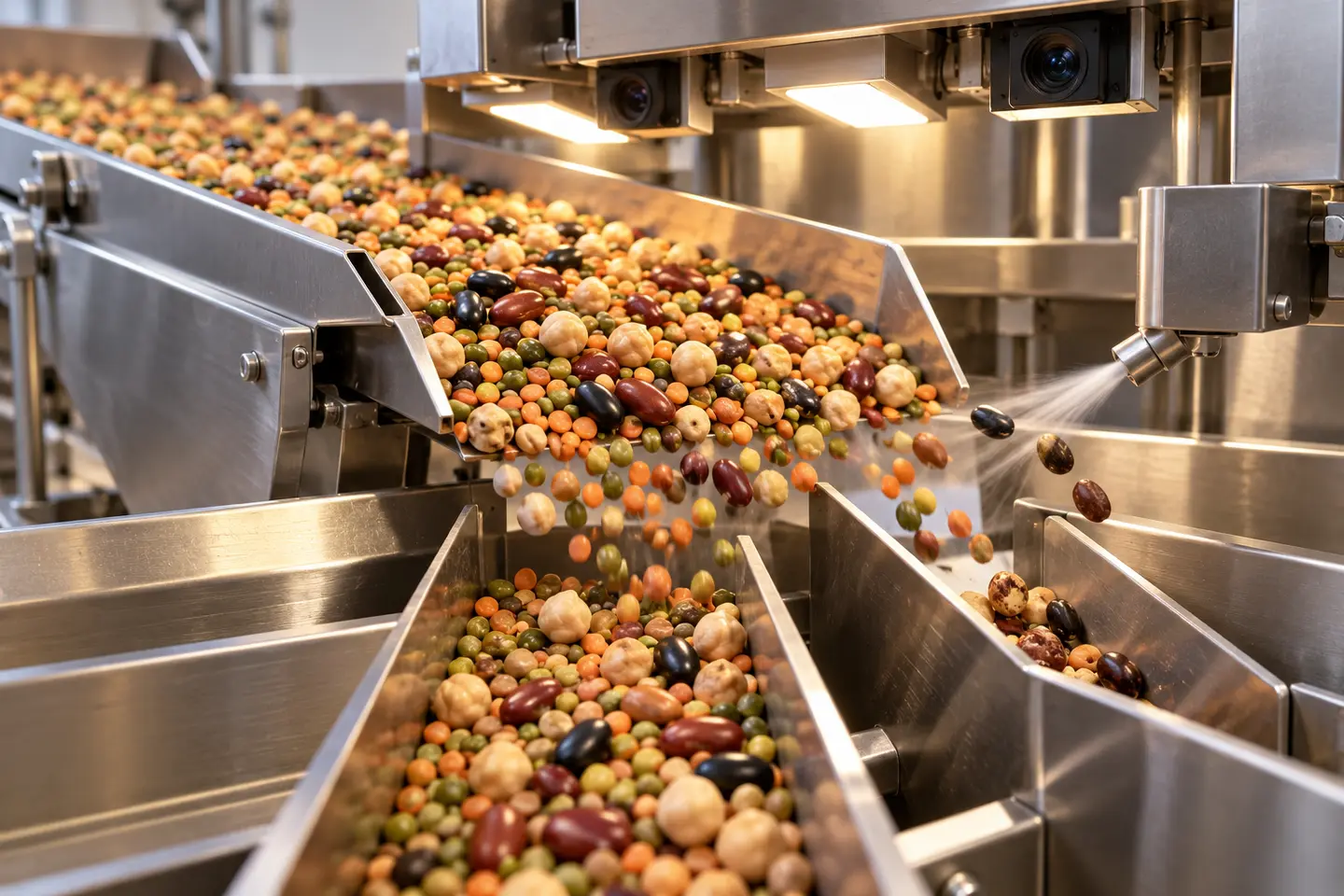
Before lentils or beans reach the bag, some pass a machine that photographs a fast-moving stream and uses tiny puffs of air to divert the odd pieces. It is quality control at the speed of a falling seed.
A bag of lentils can look remarkably orderly for something harvested by the fieldful. That neatness is not left entirely to luck. After screens and other cleaning equipment have separated material by traits such as size or weight, some processors give the moving crop one more audition: an optical sorter lets light, cameras and a row of air valves decide which pieces stay in the main stream.
The first challenge is presentation. Seeds need to move in a thin, controlled flow so the system can inspect them individually rather than stare at a heap. In a USDA Agricultural Research Service sorter, a vibrating hopper feeds adjacent chutes. Each seed slides to the edge, drops into view and is photographed while it is briefly on its own against a controlled background.
A standard colour camera can measure visible red, green and blue values along with clues such as shape and surface texture. More elaborate food-sorting systems can add near-infrared sensors, which measure reflected wavelengths beyond ordinary human vision. The machine is not admiring the lentils. It is turning their appearance into numbers that software can compare with examples or limits chosen for that product and job.
Then comes the wonderfully small bit of choreography. If a piece matches the programmed reject profile, the controller opens the matching air valve for an instant. A puff of compressed air nudges that piece into a reject channel while the accepted stream keeps falling. USDA researchers have used this camera-and-air approach to separate seed varieties and to divert damaged peas and beans.
The target is not always a darker seed. A 2024 study of an industrial sorter for beans, lentils and chickpeas combined two full-colour cameras with two near-infrared cameras. The researchers tuned the system to distinguish the legumes from cereal grains in a gluten-free production line, then used compressed-air jets to eject the detected contaminants. That example matters because it shows that the machine's job depends on a specific contrast, not a universal definition of a bad bean.
Optical sorting also has limits. A visible camera cannot reliably identify a problem that leaves no visible clue, and even spectral sensors only measure the wavelengths and patterns their system was designed to use. Dust, overlapping pieces, lighting, crop variety and overly broad settings can all complicate a decision. Processors therefore validate settings for the actual product, and optical sorting works as one checkpoint in a larger cleaning and quality-control sequence.
There is a useful human lesson hiding in all that machinery: 'uniform' is a specification, not a natural state. Official USDA bean standards distinguish classes and set tolerances for contrasting beans and other classes. The sorter helps a processor apply chosen criteria quickly, but people still define the acceptable sample, check the outputs and decide what happens to each stream.
So when a scoop of lentils pours out in a tidy little cascade, picture the earlier cascade at the sorter. For a split second, every piece may have had a close-up, a numerical verdict and, for a select few, a very brisk change of direction. The pantry is calmer because somewhere upstream, the beans faced the flash.
Sources
You may also like these