Kitchen Myth-Busting
Nuke the Rumour: What Microwaves Actually Do to Nutrients
A microwave is not a special nutrient eraser. Time, temperature, water and the food itself matter more than the appliance’s dramatic little hum.
The microwave has a public-relations problem. Its invisible waves, glowing clock and urgent beeps can make reheating soup feel like a science-fiction experiment. That atmosphere has helped one stubborn claim linger: microwaving food supposedly wipes out its nutrients. The evidence gives the appliance a much less dramatic role.
Microwave ovens use non-ionizing electromagnetic energy. According to the U.S. Environmental Protection Agency, that energy makes molecules in food move and generate heat; it does not make the food radioactive. The oven is delivering heat by a different route, not adding a mysterious nutrient-destroying ingredient.
Once food gets hot, the familiar cooking variables take over. Some vitamins are sensitive to heat. Water-soluble nutrients can also move into cooking liquid, especially when food sits in plenty of water and that liquid is discarded. Time matters too: a short trip to tender-crisp is a different experiment from repeated overheating until the vegetables surrender.
That is why the appliance name alone cannot predict the result. The U.S. Food and Drug Administration says microwave cooking does not reduce nutritional value more than conventional cooking and may retain more vitamins and minerals because it can cook quickly without added water. That is a comparison of typical conditions, not a promise that every microwaved food keeps every nutrient.
A study of ten vegetables makes the nuance useful. Researchers compared boiling, blanching, steaming and microwaving, then measured several vitamins. No single method won every vegetable-and-vitamin combination. Microwaving produced the greatest vitamin K loss in crown daisy and mallow but the least in spinach and chard. The authors’ broader conclusion was that the outcome depends on both the vegetable and the cooking process.
Think of nutrient retention as four dials: heat, time, water and what happens to the cooking liquid. A microwave often lets you turn down the time and water dials, which can be helpful for water-soluble vitamins. Boiling can still be perfectly sensible when the liquid stays in the dish—lentil soup does not pour its broth down the drain—and cooking can improve texture, flavour and access to some compounds even while reducing others.
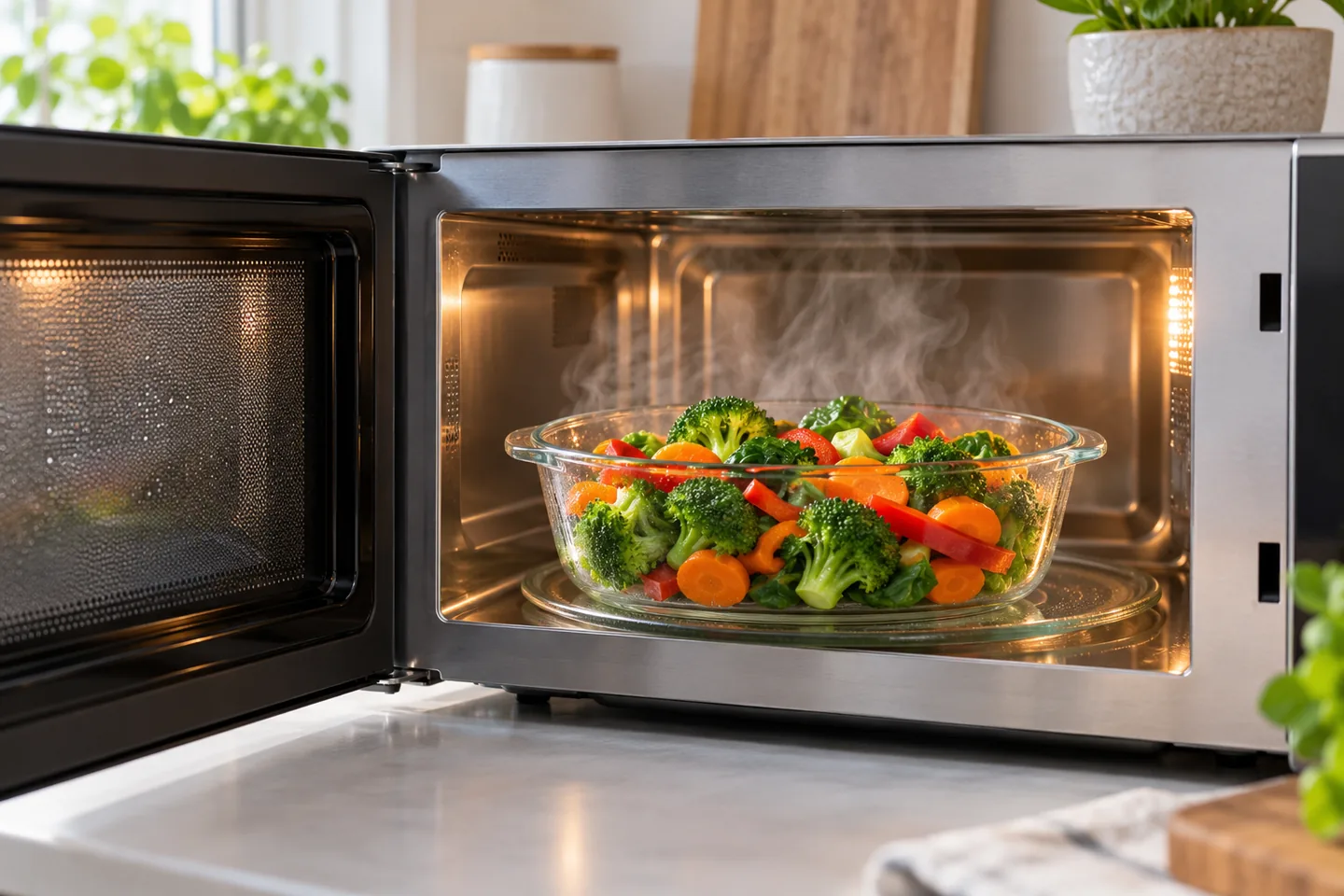
For everyday vegetables, use a microwave-safe glass or ceramic dish, add only the small amount of water needed to create steam, cover loosely so steam can vent, and stop when the food reaches the texture you want. Stir or rearrange larger portions because microwave heating can be uneven. The U.S. Department of Agriculture also recommends standing time after heating so heat can continue to spread through the food.
The practical question, then, is not ‘microwave or nutrients?’ It is ‘how much heat, for how long, with how much water?’ Use those dials thoughtfully and the microwave becomes what it has been all along: a fast cooking tool, not a tiny vitamin vacuum.
Sources
- https://www.fda.gov/radiation-emitting-products/resources-you-radiation-emitting-products/microwave-ovens
- https://www.epa.gov/radtown/non-ionizing-radiation-used-microwave-ovens
- https://www.fsis.usda.gov/food-safety/safe-food-handling-and-preparation/food-safety-basics/cooking-microwave-ovens
- https://pmc.ncbi.nlm.nih.gov/articles/PMC6049644/
You may also like these