
Kitchen Myth-Busting
Pinch, Please: Does Salt Really Make Water Boil Faster?
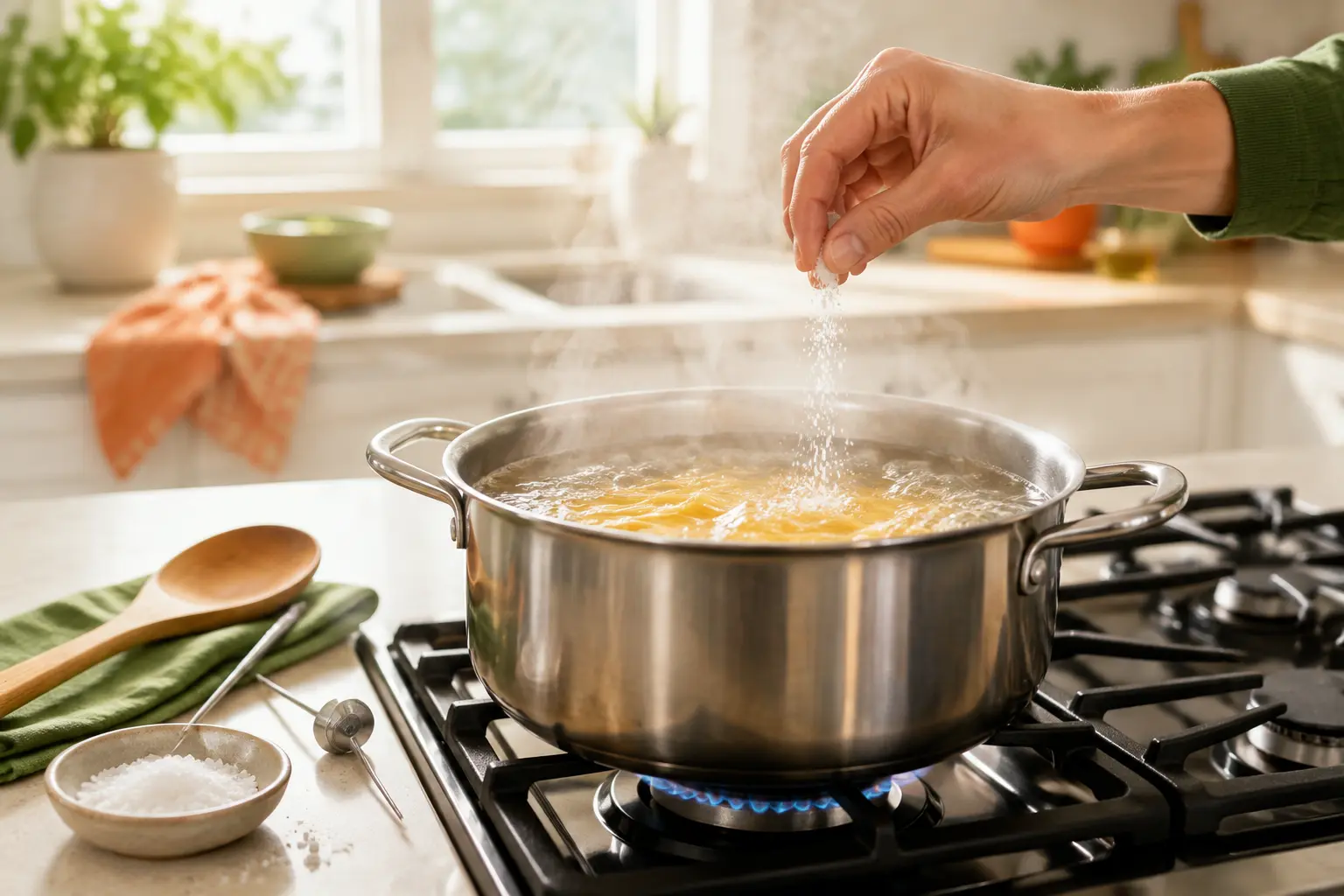
Salt changes boiling water, but not in the speedy direction most kitchen folklore suggests. The real effect is tiny, measurable and much more useful for flavour than for racing the clock.
A watched pot may never boil, but a salted pot does not win the race. The familiar advice to toss in salt so water boils faster sounds scientific enough to survive by the stove. There is just one small problem: dissolved salt actually raises water’s boiling point.
Water boils when its vapour pressure matches the pressure around it. Dissolve table salt in the water and the sodium chloride separates into charged particles. Those particles make it a little harder for water molecules to escape into the vapour phase, so the liquid must reach a slightly higher temperature before steady boiling begins. Chemists call this boiling-point elevation.
The effect is real, but dinner-sized amounts barely move the thermometer. University of Illinois physicists calculate that 29.2 grams of salt in one kilogram of water raises the boiling point by about 0.5 C. A typical teaspoon of table salt in a litre of water is only around one-fifth of that amount, so its expected effect is roughly a tenth of a degree. Crystal size and spoon-filling habits vary, but the kitchen conclusion does not: you would need an aggressively salty pot to create a meaningful temperature increase.
Why, then, does a nearly boiling pot sometimes erupt in bubbles the instant salt lands? The grains can provide places where vapour bubbles begin forming, a process called nucleation. That sudden fizz is visually persuasive, but it does not mean the salt lowered the boiling point or supplied free heat. Once dissolved, the salt-water mixture still has the slightly higher boiling point.
Salt can change other thermal properties too, and exact heating time depends on the pot, burner, lid, water volume and starting temperature. In an ordinary kitchen, those factors swamp the tiny boiling-point shift from a seasoning-sized dose. Covering the pot while it heats and starting with no more water than the food requires will usually matter far more to the clock.
For pasta, the useful reason to salt the water is flavour. Illinois Extension notes that pasta absorbs water and some salt as it cooks. A controlled 2019 study found a roughly linear relationship between the salt concentration in cooking water and the sodium retained by cooked pasta. A 2025 in-vitro digestion study likewise found that cooking method affected the sodium content and availability in several pasta types, although the authors called the work preliminary. In other words, the salt is not merely cheering from the sidelines; some of it joins dinner.
That makes the sauce part of the decision. If olives, capers, miso, jarred sauce or another salty ingredient is waiting in the pan, use a lighter hand in the pot and adjust at the end. If the sauce is simple and low in salt, seasoned cooking water can keep the noodles from tasting bland inside. Package directions and personal dietary guidance still take priority over any dramatic instruction to make the water taste like the sea.
Adding salt before or after the water heats does not unlock a speed trick. The same water and salt must ultimately reach the same salted-water boiling point. Adding it early may be marginally more energy-efficient because the pot spends less time hovering near boiling, but the difference is too small to reorganize dinner around. Add it when it is easiest to measure and remember.
Atmospheric pressure is the real heavyweight in this story. At higher elevations, lower air pressure lets water boil at a noticeably lower temperature, which can lengthen cooking times. That change can be several degrees, while ordinary pasta-water salting shifts the boiling point by only a fraction of one degree.
So keep the salt shaker by the stove, just give it the correct job description. It is a seasoning tool, not a tiny kitchen turbocharger. The pot will boil when the burner, water and air pressure are ready, no matter how impatiently the salt tries to look busy.
Sources
- https://van.physics.illinois.edu/ask/listing/1457
- https://pubs.acs.org/doi/10.1021/ed4003404
- https://extension.illinois.edu/blogs/simply-nutritious-quick-and-delicious/2014-04-11-should-you-salt-water-cook-pasta
- https://pubmed.ncbi.nlm.nih.gov/30236706/
- https://academic.oup.com/ijfst/article/60/2/vvaf134/8177085
- https://www.fsis.usda.gov/food-safety/safe-food-handling-and-preparation/food-safety-basics/high-altitude-cooking