Sensory Science
Two Kinds of Hot: Why Chilli Lingers and Mustard Darts
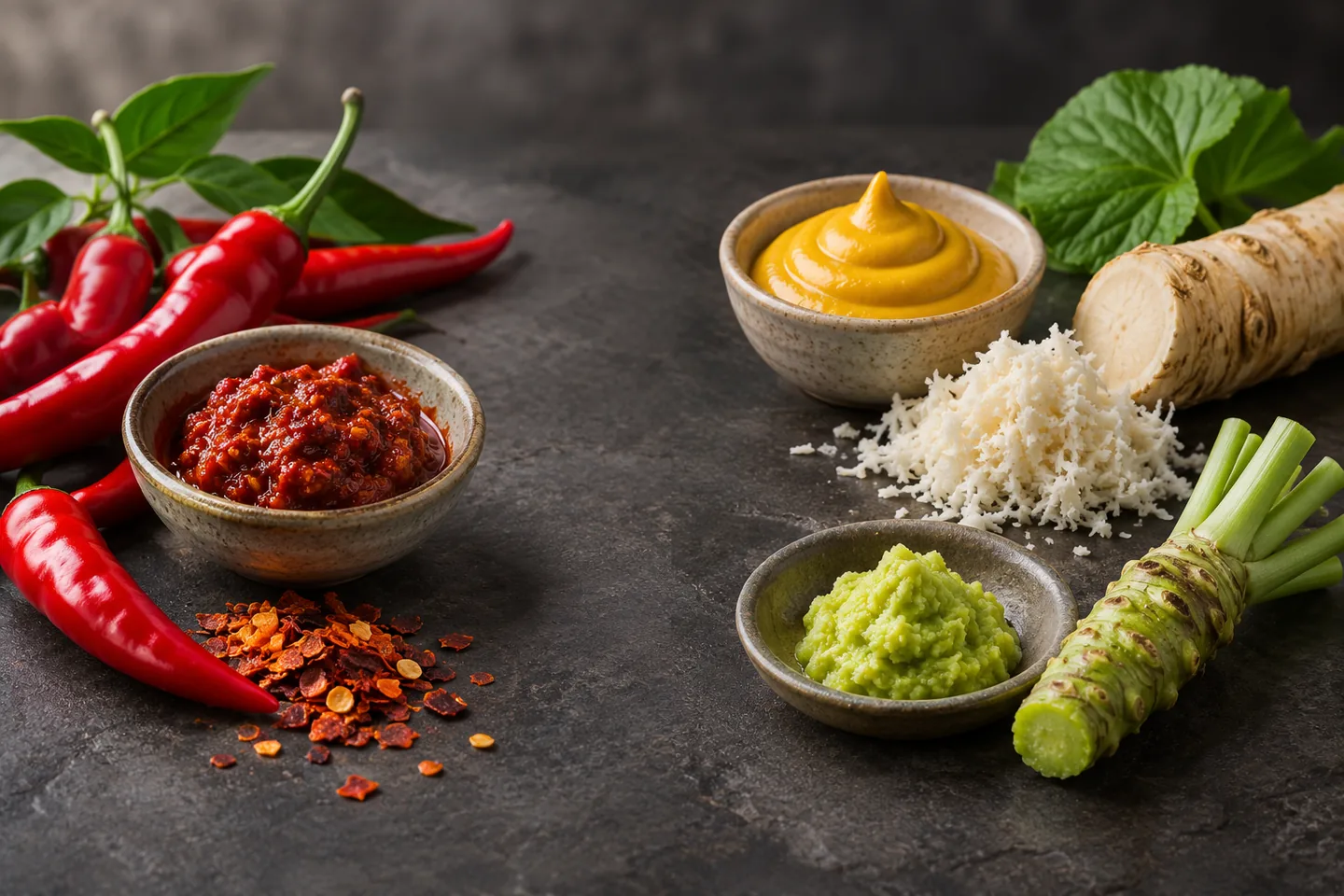
Chilli builds a mouth-filling burn, while mustard and wasabi can shoot toward the nose and vanish sooner. The split begins with different pungent compounds and different sensory channels—not with temperature.
A spoonful of chilli crisp and a dab of mustard can both feel “hot,” yet they perform very different tricks. Chilli tends to settle in and glow. Mustard, horseradish and wasabi often arrive as a bright rush that seems to climb toward the nose. Neither food has raised the temperature of your mouth. They are pressing different buttons in the body’s chemical-sensing system.
This experience is called chemesthesis: touch-like sensations caused by chemicals, including burn, cooling, tingling and irritation. It travels largely through sensory nerves rather than the receptors for the five basic tastes. That is why pungency can feel like heat even when a sauce is refrigerator-cold.
Chilli peppers bring capsaicin. In a landmark experiment, researchers identified its receptor—now called TRPV1—as an ion channel on sensory neurons. The same channel also responds to genuinely high temperatures. Capsaicin therefore borrows part of the body’s heat-warning circuitry, creating a burn without a flame.
Mustard, horseradish and wasabi usually lean on isothiocyanates, especially allyl isothiocyanate. Research identified TRPA1 as a major sensory target for mustard oil. Allyl isothiocyanate is also volatile, so molecules can move into the air and reach the nasal cavity. That combination helps explain the sharp, nose-forward quality people often notice.
The two sensations do not merely have different addresses; their timing can differ too. In a controlled human study, repeated one-minute applications of mustard oil produced declining irritation ratings, while repeated capsaicin applications increased in intensity under the same general protocol. That laboratory result does not predict every mouthful, but it supports the everyday impression that mustard can flash and retreat while chilli sometimes builds.
Chemistry adds another clue. Authoritative compound records describe capsaicin as practically insoluble in cold water, while allyl isothiocyanate is documented as a pungent volatile oil. Food is more complicated than a beaker, but those physical properties help make the contrast plausible: one compound readily lingers in a fatty food matrix; the other can announce itself through vapour as well as direct contact.
For cooks, this is a useful flavour-design choice. Chilli can supply a sustained background burn in beans, noodles, stews or roasted vegetables. Mustard, horseradish or wasabi can add a faster aromatic jab to dressings, sandwiches, mashed roots or sauces. Adding the volatile option near serving time is a reasonable kitchen inference when you want its high note to stay vivid; prolonged heat and an open pan give aroma more opportunity to escape.
Combining the two does not create one universal ladder of heat. It layers sensations with different routes and time courses, and people vary widely in sensitivity. Start modestly, taste the finished food, and adjust the long chilli glow and the quick mustard spark as separate controls.
So the next time a condiment clears your head while another warms your whole mouth, the contrast is not culinary imagination. Chilli and mustard are both playing the sensory keyboard—just on different keys, with very different sustain pedals.
Sources
You may also like these