
Kitchen History
Toast of the Town: When Breakfast Needed a Flip
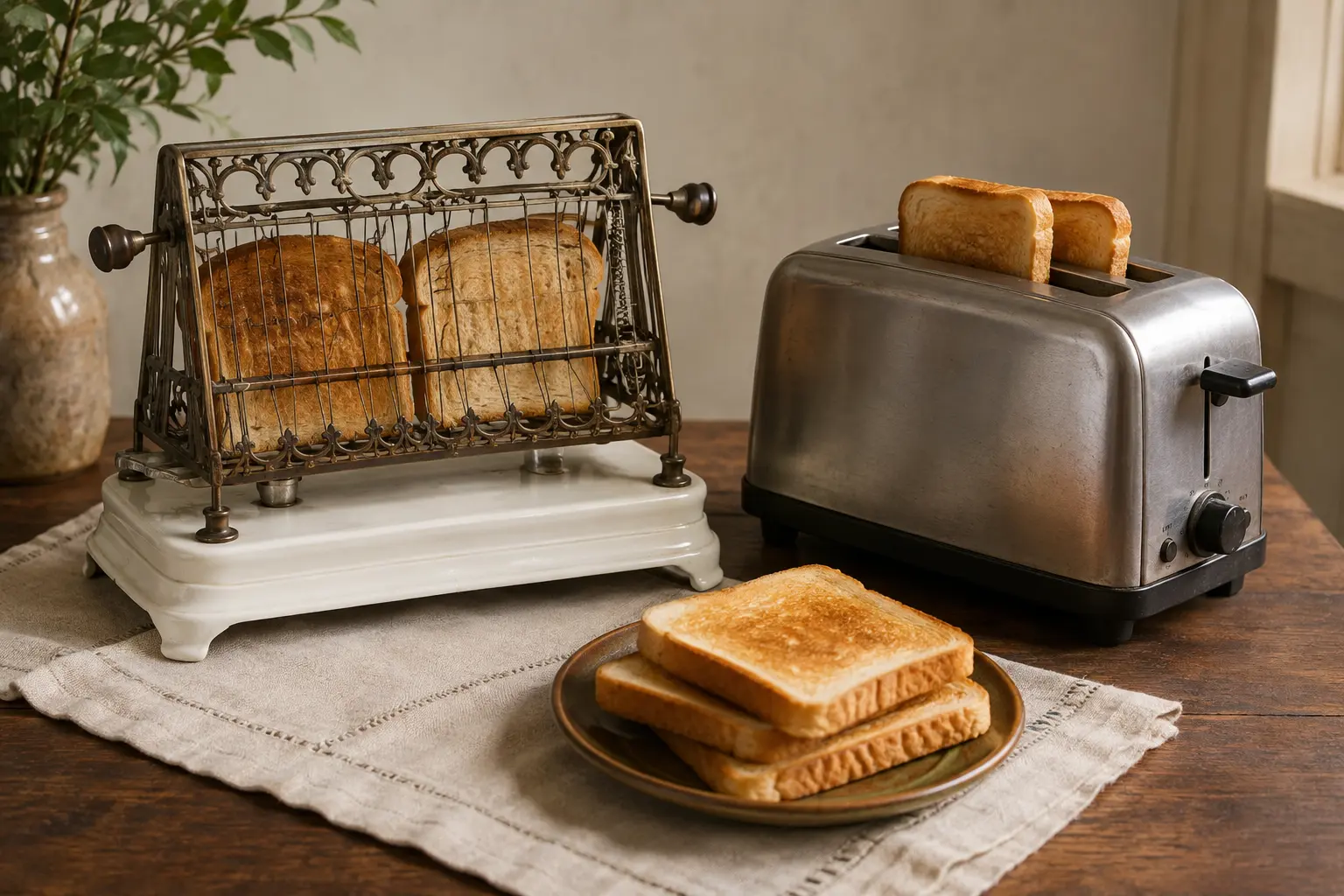
The first electric toasters asked breakfast cooks to watch exposed glowing wires and manage the bread by hand. The familiar pop-up arrived only after inventors taught the machine to time, stop and lift.
Push a lever, wait for a click and catch two warm slices. A modern toaster makes breakfast look like a one-step idea. Early electric versions told a different story: the heating element was the breakthrough, while timing and toast-lifting were still jobs waiting for inventors.
A General Electric D-12 preserved by the Smithsonian shows how open the original arrangement could be. A 1909 catalogue offered the toaster with a porcelain base and wire basket, rated at 600 watts. It was handsome enough for the table, with the bread held beside exposed heating elements rather than lowered into a closed metal box.
The quiet hero under that wirework was an alloy. The Smithsonian credits engineer Albert L. Marsh with developing nickel-chromium wire in 1905. Unlike an ordinary filament that quickly failed in open air, the new wire could glow red, cool and heat again. Wrapped around heat-resistant mica plates, it made a practical electric toaster possible.
The D-12 evolved quickly. The Smithsonian describes three versions sold from about 1908 to 1910. Designers changed the basket wires and then lowered the sides so bread could be removed more easily. What the object did not yet have is equally revealing: there was no familiar browning dial, enclosed slot or automatic lift. Watching and handling the toast remained part of breakfast.
Charles Strite's 1919 patent application tackled that missing choreography. His design let a user choose a toasting time, automatically cut the electrical current, open a hinged cover and partly lift the bread. The patent even planned to use stored heat after switch-off, showing that the goal was not simply a dramatic pop. It was controlled, repeatable browning without constant supervision.
A second Strite patent, filed in 1920, described an oven with top slots and a mechanism that moved the toast outward when the cycle finished. By the mid-1920s, enclosed automatic toasters were joining the household-appliance parade. The Smithsonian's collection records a Waters-Genter Model 1A1 from about 1926 alongside other toasters from that decade.
Seen as three separate problems, the path makes sense. First came a wire that could survive repeated red-hot cycles in air. Next came a safer structure to hold bread near it. Finally, timers, switches, springs and moving trays learned when to stop and how to return breakfast. The pop-up toaster was less one lightning-bolt invention than a tidy stack of solutions.
The history also explains why early toasters were display pieces. Before today's hidden slots and crumb trays, the appliance sat at the table where a person could watch the bread and manage the result. Decorative porcelain and metalwork were not wasted ornament on a machine meant to be seen during the meal.
The toaster itself is happily neutral about what goes inside, but bread is worth a quick label check when you are shopping vegan. Many everyday loaves are plant-based, while some enriched breads include milk, butter, eggs or honey. A machine that once demanded constant attention now leaves just enough time to read the bag.
So the next time breakfast jumps up by itself, give the little appliance more credit than a startled glance. Behind that click are heat-resistant alloy, museum-worthy wire baskets and clockwork mechanisms that spent decades learning a very useful trick: knowing when to let go of the toast.