
Sustainability Facts
Rooting Interest: The Tiny Soil Team Behind Pulses
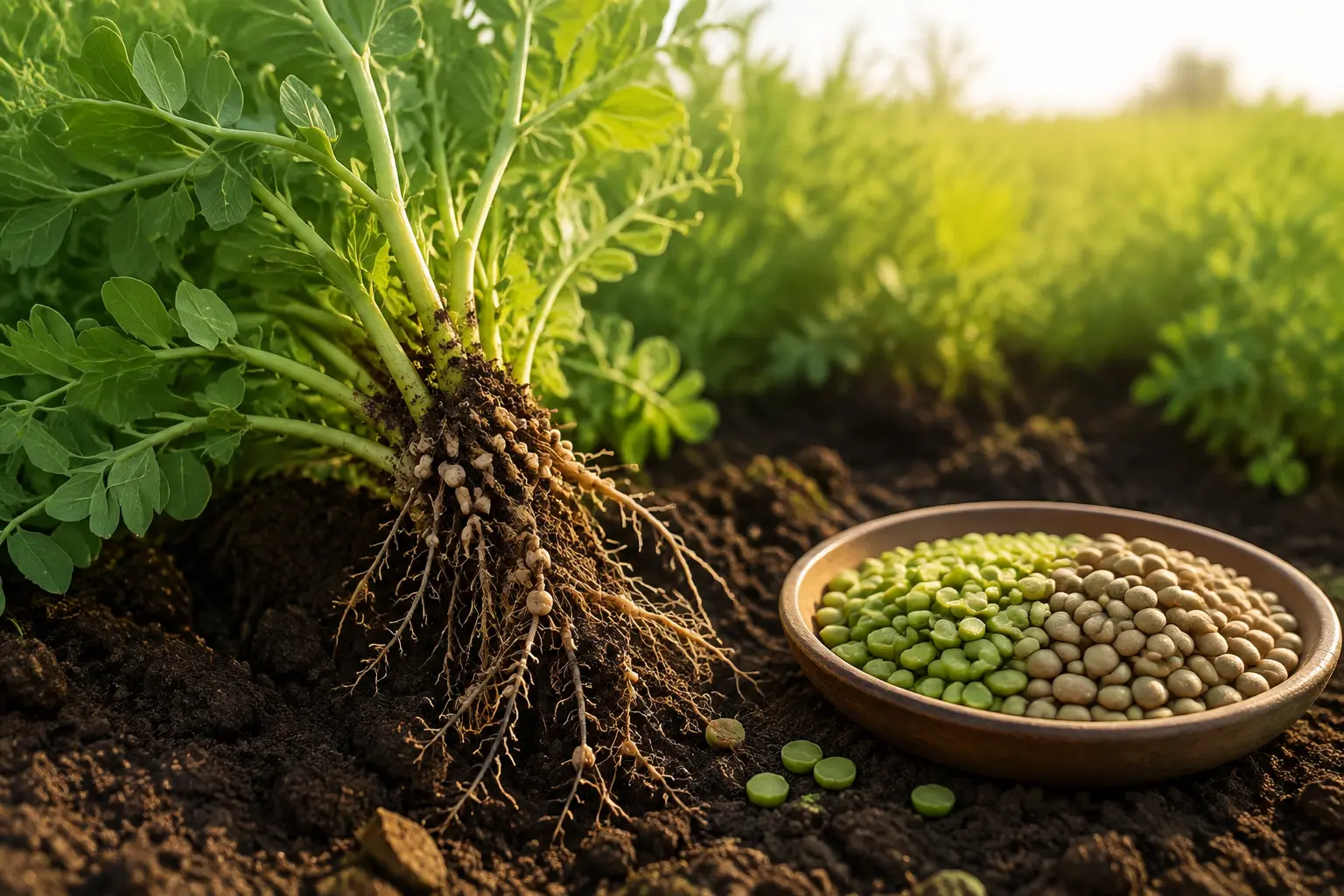
Peas, lentils, chickpeas and beans have microscopic teammates below ground. Here is how root nodules turn an atmospheric gas into plant food.
A lentil plant may look quiet above ground, but its roots can be running a remarkably lively collaboration. Peas, chickpeas, dry beans and lentils belong to the legume family, and their roots can partner with bacteria commonly called rhizobia. The visible evidence is delightfully small: rounded nodules attached to the roots, like tiny beads tucked into the soil.
The partnership solves a basic plant problem. Nitrogen gas is abundant in the air, yet plants cannot use that gas directly. Inside a root nodule, rhizobia convert atmospheric nitrogen into ammonia, a form that can enter the plant's nutrient-making machinery. The plant supplies the bacteria with sugars made through photosynthesis and gives them a protected place to work. Scientists call this biological nitrogen fixation.
That does not mean a pea plant simply makes free fertilizer by itself. The right plant and compatible bacteria must meet, nodules must form and growing conditions matter. The amount fixed varies with the crop, soil, bacterial strain and weather. Some of the captured nitrogen also leaves the field in harvested seeds, so the net benefit to soil is not identical in every farm or season.
Still, the partnership can be useful in crop rotations. The Food and Agriculture Organization of the United Nations reports that pulse crops obtain a substantial share of their nitrogen through fixation and can help make nutrients available within farming systems. Their roots and residues can contribute to nutrient cycling, while rotating crops also changes what is growing in a field from season to season.
The word pulse has a precise kitchen meaning, too. Pulses are the dried edible seeds of legumes, including dry lentils, chickpeas, dry beans and dry peas. Fresh green peas and green beans are legumes, but they are usually classified as vegetables rather than pulses. Either way, it is the living plant in the field, not the lentil waiting in your pantry, that hosts the underground bacterial crew.
If you ever see a pulse plant carefully lifted from soil, look for those little root nodules. Farmers and researchers sometimes cut one open to check its activity: effective nodules often show pink or reddish tissue because they contain leghemoglobin, a molecule that helps manage oxygen around the nitrogen-fixing process. That colour is a field clue, not a home test for anything on your dinner plate.
So the next bowl of lentil soup comes with an excellent factoid: long before the lentils reached the pot, their plant may have housed a microscopic nutrient workshop underfoot. It is less a solo superpower than a very small, very efficient team project.