
Food History
Peanut Gallery: Three Records Behind a Familiar Jar
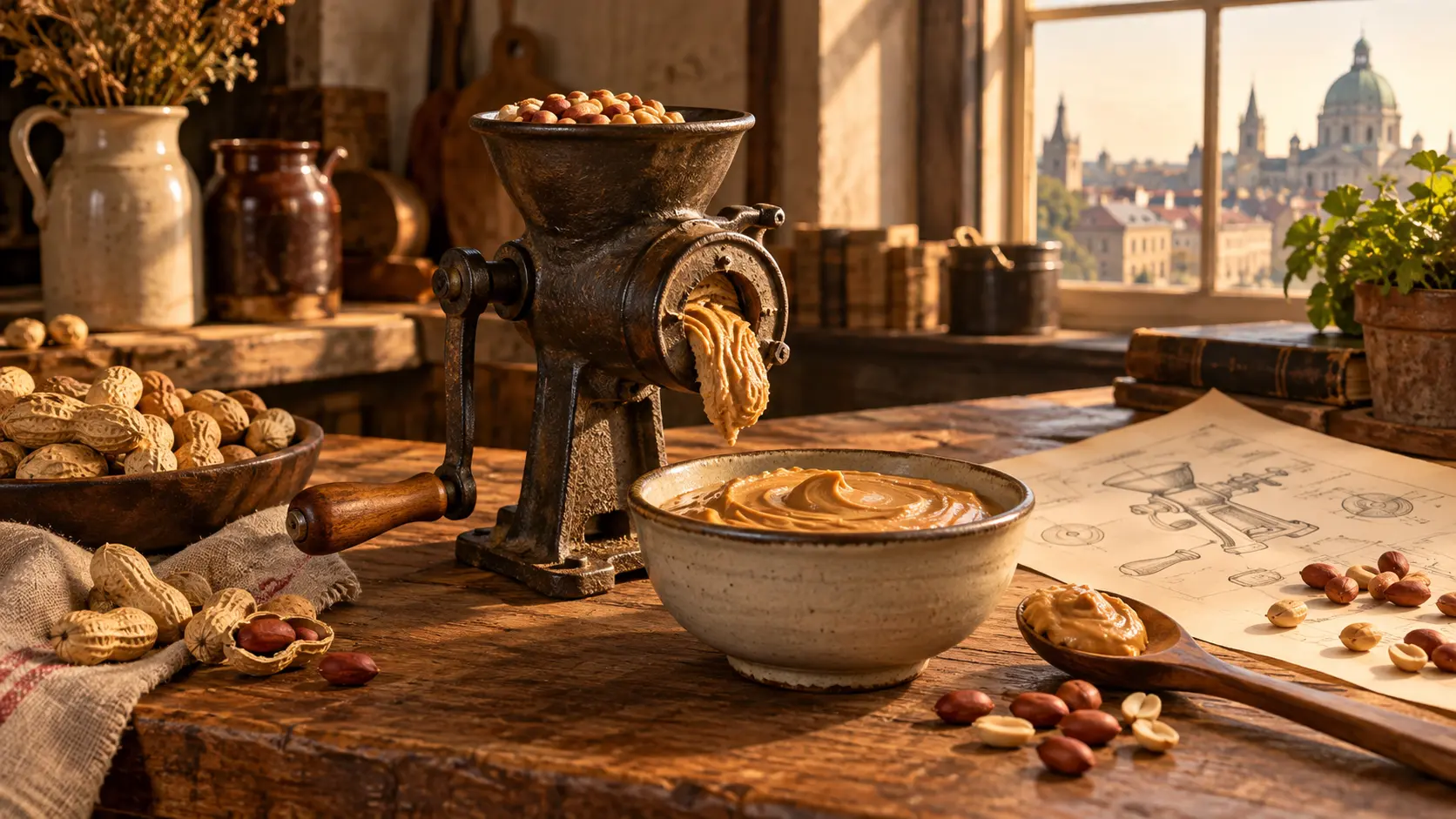
A Montreal patent, a famous agricultural educator and a modern food rule each hold a different piece of peanut butter's story. Open the records and the familiar jar becomes much more interesting.
Peanut butter feels so settled into the pantry that it is easy to imagine it arriving fully formed, label and sandwich included. The paper trail tells a more interesting story. Three records, separated by decades, show how a warm-ground paste, an agricultural educator and a modern product definition each helped shape what we now recognize in the jar.
Record one is a U.S. patent issued on October 21, 1884 to Marcellus Gilmore Edson of Montreal. Edson described roasting shelled peanuts and grinding them between surfaces heated to roughly 100°F. He wrote that cold grinding could leave peanut flour, while warm grinding released enough oil to make a fluid or semi-fluid paste. Once cooled, it set to a butter-like consistency and could soften again when warmed.
The patent was formally titled 'Manufacture of Peanut-Candy,' which gives the earliest paste a different job from today's lunchbox spread. Edson proposed combining it with sugar for sweetmeats and candy. In other words, the document captures a useful processing idea, not the final blueprint for every modern jar.
Record two belongs to George Washington Carver. The U.S. National Park Service describes Carver as an educator and research scientist who taught crop rotation, promoted alternative cash crops and developed hundreds of applications for peanuts, sweet potatoes and pecans. His long work at Tuskegee helped make peanuts useful to farmers and industry, but this sits later in the timeline than Edson's patent. The records are a good reminder that food history is often a relay rather than a single light-bulb moment.
Record three is much newer and much more specific. In the United States, the current federal standard says peanut butter is made by grinding shelled, roasted peanuts. Seasoning and stabilizing ingredients may be added, but together they cannot exceed 10 percent of the finished food's weight. That definition does not apply everywhere, yet it shows how a once-experimental paste eventually became precise enough to require an official recipe boundary.
Read together, the three records do different jobs. The patent explains a warm-grinding technique. Carver's biography shows how peanut research and agricultural teaching widened the crop's possibilities. The regulation draws a line around what a product labelled peanut butter must contain in one major market.
There is also a small kitchen lesson hiding inside the history. Peanuts already contain substantial oil, so grinding breaks their structure and lets that oil help turn particles into paste. A home food processor repeats the basic transformation, although modern equipment, roasting choices and optional salt or sweeteners give cooks far more control than an 1884 mill.
So the next time a spoon disappears into the jar, picture more than one inventor standing behind it. Picture a heated mill in Montreal, decades of crop education and research, and a modern rulebook trying to define where peanuts end and peanut butter begins. That is a lot of history packed into one very sticky spoonful.