Food History
Ground Control: The Paper Filter That Tidied Up Coffee
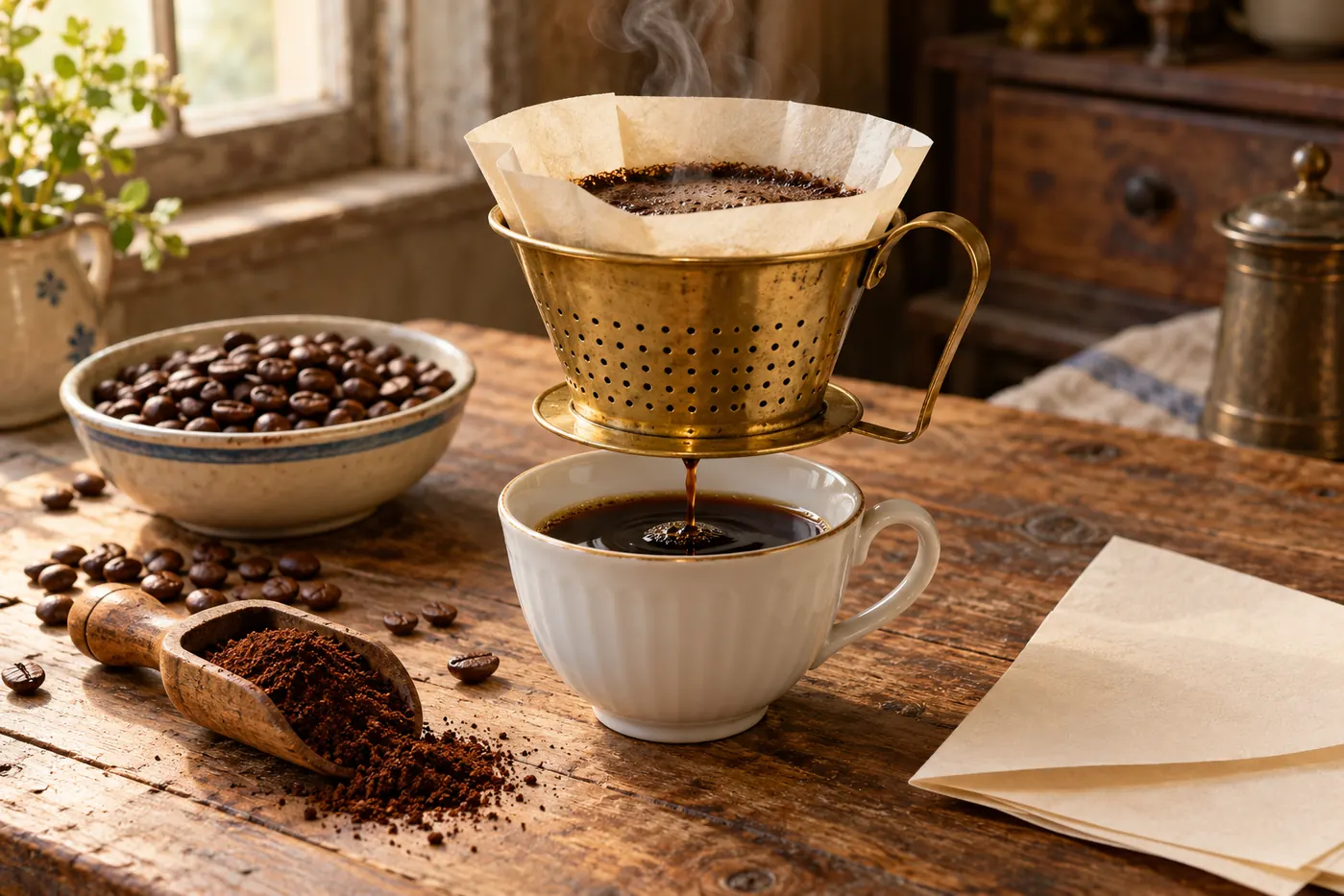
In 1908, Melitta Bentz paired a perforated brass cup with blotting paper, turning a small kitchen fix into a cleaner way to brew coffee.
A century ago, a quiet cup of coffee could come with an unwanted encore: grounds at the bottom and a murky final sip. In Dresden, Melitta Bentz treated that everyday nuisance like a design brief. Her answer was not a complicated machine. It was a metal cup, a piece of paper and a very good question: what if the grounds could stay behind?
The German Patent and Trade Mark Office describes the problem she was working around. Coffee was commonly made by adding ground beans to hot water and waiting for the particles to settle, or by pouring the mixture through a sieve. Fine holes could clog; larger holes could let grounds return to the cup. Either route could leave the drink cooler and less clear than intended.
Bentz experimented with a roughly perforated brass cup. She then cut a sheet of blotting paper from her son's exercise book to fit inside it. Hot water could pass through the bed of coffee and the paper while the solid grounds remained above. The clever part was not paper alone or holes alone, but putting the two together as a simple disposable barrier inside a reusable holder.
On June 20, 1908, Bentz registered the filter as a utility model with the Imperial Patent Office in Berlin. The official title was rather less perky than the invention: a coffee filter with a curved, recessed base and angled flow holes. The protection was entered on July 8, and a company built around the filter joined the commercial register that December, initially operating from a room in the family's apartment.
The idea moved quickly from kitchen experiment to public demonstration. The patent office reports that the first run included 50 filter bodies and 100 cartons of paper. Bentz and her husband showed the device in shops and at private coffee gatherings; at the 1909 Leipzig Trade Fair, more than 1,200 filters were sold. A domestic irritation had become a repeatable brewing system.
The familiar cone did not arrive fully formed. During the 1930s, the round metal holder evolved into a porcelain quick filter with an oval, tapered base. Matching shaped paper rested against ribs inside the holder, giving water paths around the filter instead of pressing every part flat against the wall. That later geometry helped establish the cone-and-paper arrangement many pour-over brewers still recognize.
A paper filter does not guarantee an excellent cup by itself. Grind size, water, temperature, dose and contact time still matter. The Coffee Association of Canada offers one especially tidy modern lesson: when a brewer needs a filter, fit it snugly and spread the grounds evenly. That reduces the chance that water will bypass the coffee bed and produce a weak, uneven brew.
So the next time a paper filter folds into place, notice how modest the invention looks. Its history is a reminder that useful food technology does not always begin in a laboratory or arrive with a motor. Sometimes it starts with a gritty last sip, a scrap of paper and someone unwilling to accept that the grounds simply belong there.
Sources
- https://www.dpma.de/english/our_office/publications/ingeniouswomen/melittabentz/index.html
- https://www.dpma.de/english/our_office/publications/ingeniouswomen/110jahrekaffeefilter/index.html
- https://invention.si.edu/invention-stories/starting-day-right-coffee-innovations
- https://coffeeassoc.com/how-to-brew-coffee/
You may also like these