Food History
Yes We Can: The Opener Arrived Decades After the Tin
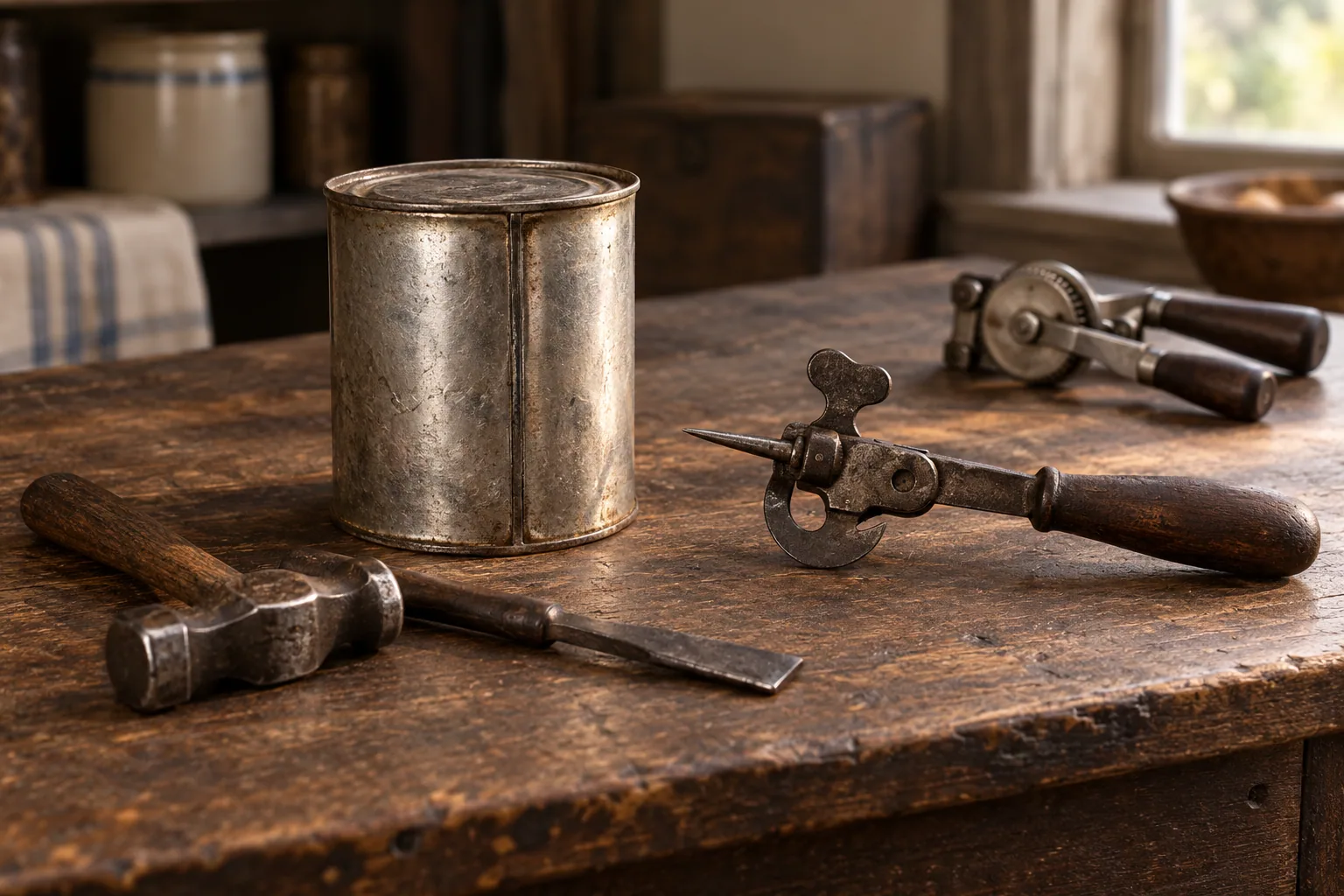
Canned food spent decades waiting for its own purpose-built opener. The pantry staple arrived first; the familiar turning tool was a much later chapter.
A modern pantry makes the partnership look inevitable: can, opener, dinner. Yet the container and its dedicated tool did not arrive as a matched set. Preserved food was already being sealed for long storage while cooks were still expected to attack sturdy metal lids with whatever heavy tool was available.
The quickest way to see the mismatch is to begin with the missing piece. Ezra J. Warner's American patent for an instrument to open cans is dated January 5, 1858. His tool first pierced the tin, then used a curved cutter while a looped bar steadied it against the can. The patent emphasized a smoother, faster cut and a piercing action designed to keep liquid from spurting out. Clever, yes, but it looked more like a compact hand tool than the opener beside most kitchen drawers today.
Now rewind nearly half a century. Nicolas Appert's early nineteenth-century preservation method placed prepared food in sealed glass bottles and heated them. His 1812 English-language book, now digitized by the Library of Congress, described ways to preserve a remarkable range of plant and animal foods for years. The method worked before scientists had a full explanation for the microbes and heat involved.
Metal changed the container while the convenient opener was still waiting. Connecticut History traces the British tin-lined iron can to an 1810 patent associated with Peter Durand. These early cans were built for strength, not effortless lunch preparation. Some were so substantial that contemporary opening advice amounted to cutting around the top with a chisel and hammer.
Put those records beside each other and the oddity becomes clear: the metal can had been around for almost half a century before Warner's patented opener. The gap suggests a simple design lesson. A system can solve its biggest problem first, in this case keeping food stable during storage and transport, while leaving everyday convenience for later inventors.
William W. Lyman moved the idea closer to the familiar turning motion in 1870. His patent used a centre pivot and a rotating cutter that travelled around the lid. The operator still had to pierce the centre and adjust the tool to the can's size, so it was not yet the tidy edge-gripping opener we know. Still, the cutter now rolled in a circle rather than being worked forward one bite at a time.
The can opener was therefore not one sudden eureka moment. It was a chain of responses to changing containers: piercing, levering, rolling, gripping and eventually building easy-open features into the lid itself. Each step made the package and the person opening it behave a little more like one coordinated system.
That long-running partnership now quietly supports a very vegan sort of convenience. Chickpeas, tomatoes, coconut milk, beans, pumpkin and jackfruit can wait patiently for a quick meal, while a small kitchen tool finishes the job in seconds. The next time a lid turns neatly away, give the opener a little credit. It joined the pantry late, then made itself indispensable.
Sources
You may also like these