Food History
Winter Set: How Cold Weather Turned Seaweed Jelly into Agar
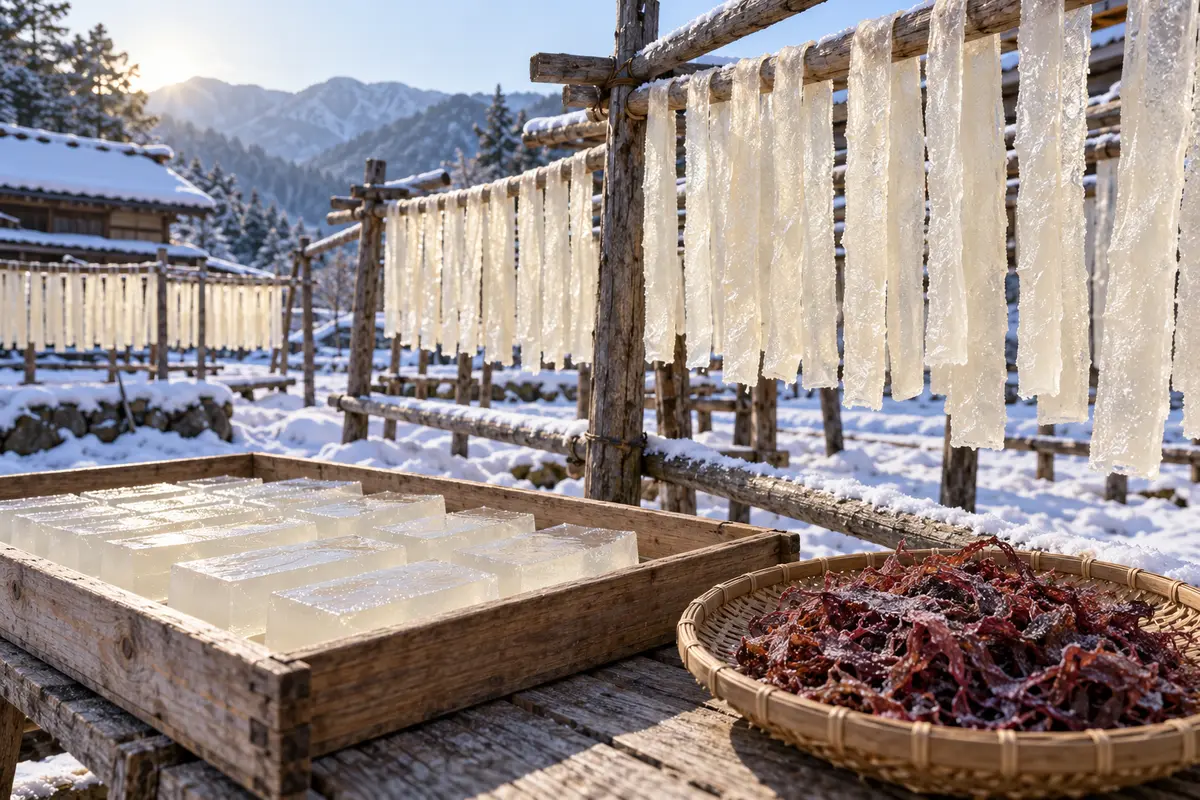
Long before agar came in pantry packets, winter nights helped turn seaweed jelly into a dry, portable ingredient that could become jelly all over again.
A pot of seaweed jelly, a freezing night and a patient thaw sound like the ingredients for a kitchen mishap. In the traditional story of agar, they are the plot twist. Japanese accounts place the discovery of dried agar—called kanten—in the late 1650s or early 1660s. The tale credits an innkeeper who discarded leftover seaweed jelly outdoors, then noticed that freezing, thawing and drying had left a light material that could be boiled with water and set again. The accident is a legend rather than a lab notebook, but the process it describes is real.
Agar begins in the cell walls of certain red seaweeds. A 2024 scientific review identifies Gelidium and Gracilaria as the two main commercial sources. Producers wash the seaweed, heat it in water to dissolve the agar, and filter away the plant material. When the hot filtrate cools, it becomes a gel—and that gel is roughly 99 percent water, according to the UN Food and Agriculture Organization.
Here is where winter earns its billing. In the traditional method, the gel is cut or extruded into strips and left outdoors. Cold nights freeze the water into ice crystals. Warmer daytime conditions thaw the gel, allowing much of that water—and some dissolved salts and other soluble material—to drain away. Repeated freezing, thawing and drying turns a wobbly jelly into a much lighter, concentrated product that can be stored and transported.
That seasonal technique also helps explain the Japanese name kanten, often associated with cold weather. Japan’s Ministry of Agriculture, Forestry and Fisheries describes regional kanten-making in which dissolved and filtered seaweed gel is repeatedly frozen during intensely cold nights and sun-dried during the day. Dried sticks could be kept for long periods, then dissolved again for sweets and savoury dishes served at family gatherings.
Modern factories do not have to wait for a cooperative forecast. They can use controlled refrigeration for freeze–thaw dehydration or press water from the gel before hot-air drying. The equipment changed; the useful sequence did not: extract, filter, set, remove water, dry and mill or shape.
Agar’s kitchen personality is unusual too. FAO guidance says many food-grade agars set as they cool at roughly 32–43°C, yet do not melt again until about 85°C or higher. That wide gap is why an agar gel can stay firm well above room temperature. It also explains why agar is not a perfect one-for-one imitation of gelatin: its gel is generally firmer and more brittle, and it does not melt softly in the mouth at body temperature.
For a home cook, the practical lesson is simple. Agar must first dissolve in very hot or boiling liquid; merely sprinkling it into a cold mixture will not unlock its setting power. Once dissolved, it begins to form a gel as the mixture cools. The exact firmness depends on the agar, concentration and recipe, so a tested formula beats an improvised spoonful.
The charming winter-night origin story may never be provable in every detail. What is well documented is the clever physical process behind it: freezing separates water from a seaweed gel, thawing lets that water escape, and drying preserves what remains. A centuries-old cold snap helped give vegan kitchens one of their most heat-stable ways to make a wobble.
Sources
You may also like these