Food Research
Panel Discussion: Why Crops Don’t All Agree on Solar Shade
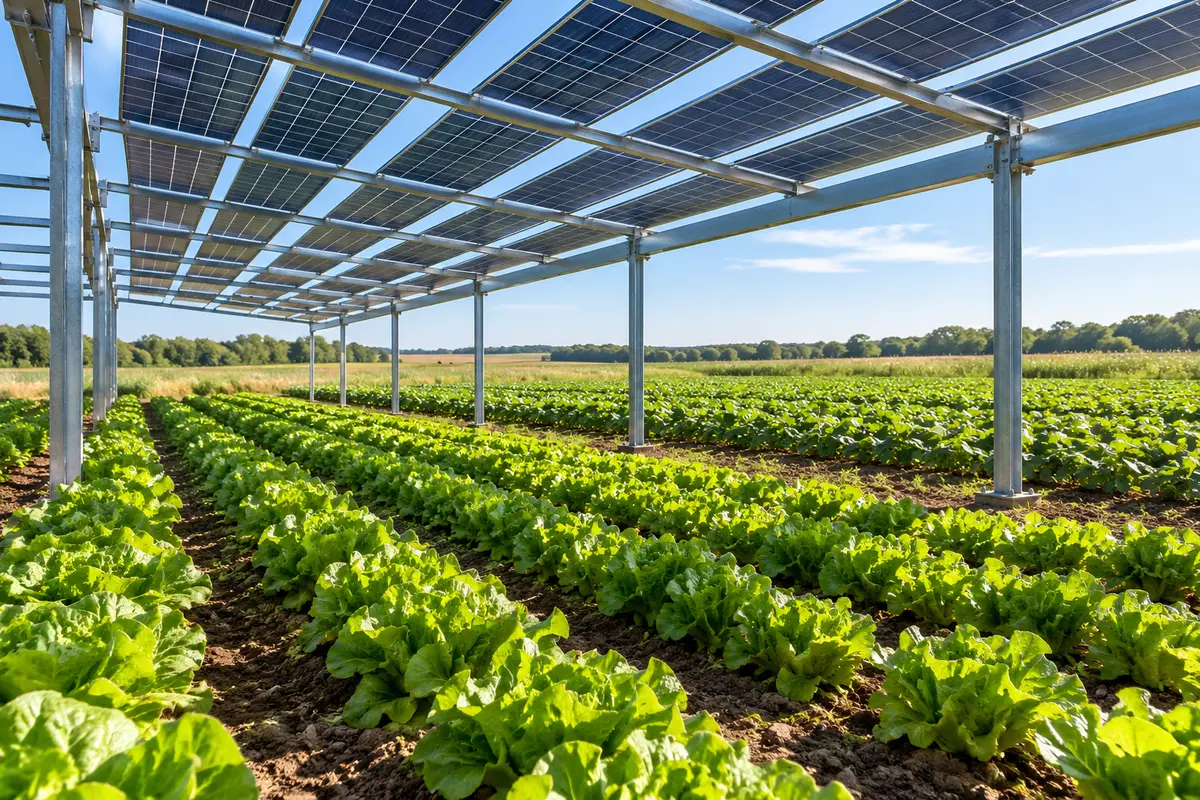
New 2026 field studies show that growing food under solar panels is not a simple shade-is-good story. Rice held steady in one trial, soybeans and sweet potatoes fell, and lettuce responded to panel colour and transparency.
A solar panel and a head of lettuce can share a field, but they still have to negotiate the sunlight. Agrivoltaics is the practice of growing crops, grazing animals or supporting pollinator habitat beneath or between solar panels. The appealing idea is to produce food and electricity from the same land. The tricky part is that a useful roof for one crop can feel like a blackout curtain to another.
Two studies published in 2026 make that tension unusually clear. They do not deliver one verdict for every farm. Instead, they show why the crop, cultivar, panel, climate and harvest target all belong in the same conversation.
A September study in the journal Solar Energy tested lettuce in cold frames covered with semi-transparent photovoltaic materials. The researchers compared neutral, red, green and blue panels. All four treatments changed the growing environment and increased lettuce height. Under those specific cold-frame conditions, the neutral panel produced the strongest overall growth and yield; the paper reported yield increases of 300% for neutral, 210% for green, 161% for red and 120% for blue compared with its control.
Those striking percentages are a result from one experimental system, not a promise that any lettuce placed under a solar panel will quadruple. Semi-transparent panels change more than the total amount of light. Their colour changes which wavelengths reach the leaves, while the structure can also alter temperature, humidity and the timing of shade. A leafy crop harvested for its above-ground growth may respond very differently from a crop expected to fill pods, grains or underground storage roots.
That contrast appears in a February study in npj Sustainable Agriculture. Researchers measured rice, soybeans and sweet potatoes on working agrivoltaic farms in Japan. Rice grain yield remained statistically stable under 27% shade. Soybean seed yield fell by about 31% under 33% shade. Conventional sweet potato tuber yield fell by about 40% under 31% shade, while organically grown sweet potato cultivars showed widely different responses under 40% shade across two years.
The plants were not simply sitting still and receiving fewer photons. They were responding to a light environment that suggested competition. The study tracked shade-avoidance traits such as taller plants and shifts in the balance between shoots and roots. That strategy can help a wild plant reach above its neighbours, but it may redirect resources away from the part a farmer wants to harvest. Taller soybean stems do not compensate for fewer pods, and longer sweet potato vines do not guarantee heavier tubers.
Variety mattered too. In the 2024 sweet potato trial, two cultivars lost yield under the panels while three did not differ significantly from their open-field controls. The rice result also came with useful cautions: it involved one glutinous cultivar and one year of field data. The panels slightly cooled air and water during an unusually hot summer, which may have helped, but the researchers said longer studies are needed before treating that as a general advantage.
The lettuce and staple-crop studies are not really contradictory. They are reminders that agrivoltaics is a design problem, not a single product. Panel height, spacing, transparency and colour shape the light below. Local weather changes whether some shade offers relief or removes a scarce resource. The crop then decides, through its own biology, what to do with that altered day.
When a headline says solar panels helped a crop, five questions make the result easier to read: Which crop and cultivar? How much shade reached it? Was the panel opaque or semi-transparent? What climate and control plot were used? And was success measured in leaves, seeds, fruit or roots? Those details turn a dazzling percentage into information that might travel beyond one field.
The most useful conclusion is not that panels are good for lettuce or bad for sweet potatoes. It is that sharing sunlight requires matchmaking. The field may have room for both food and electricity, but the seating plan matters.
Sources
You may also like these