Food Research
Berry Good Armour: When Fruit Scraps Guard Strawberries
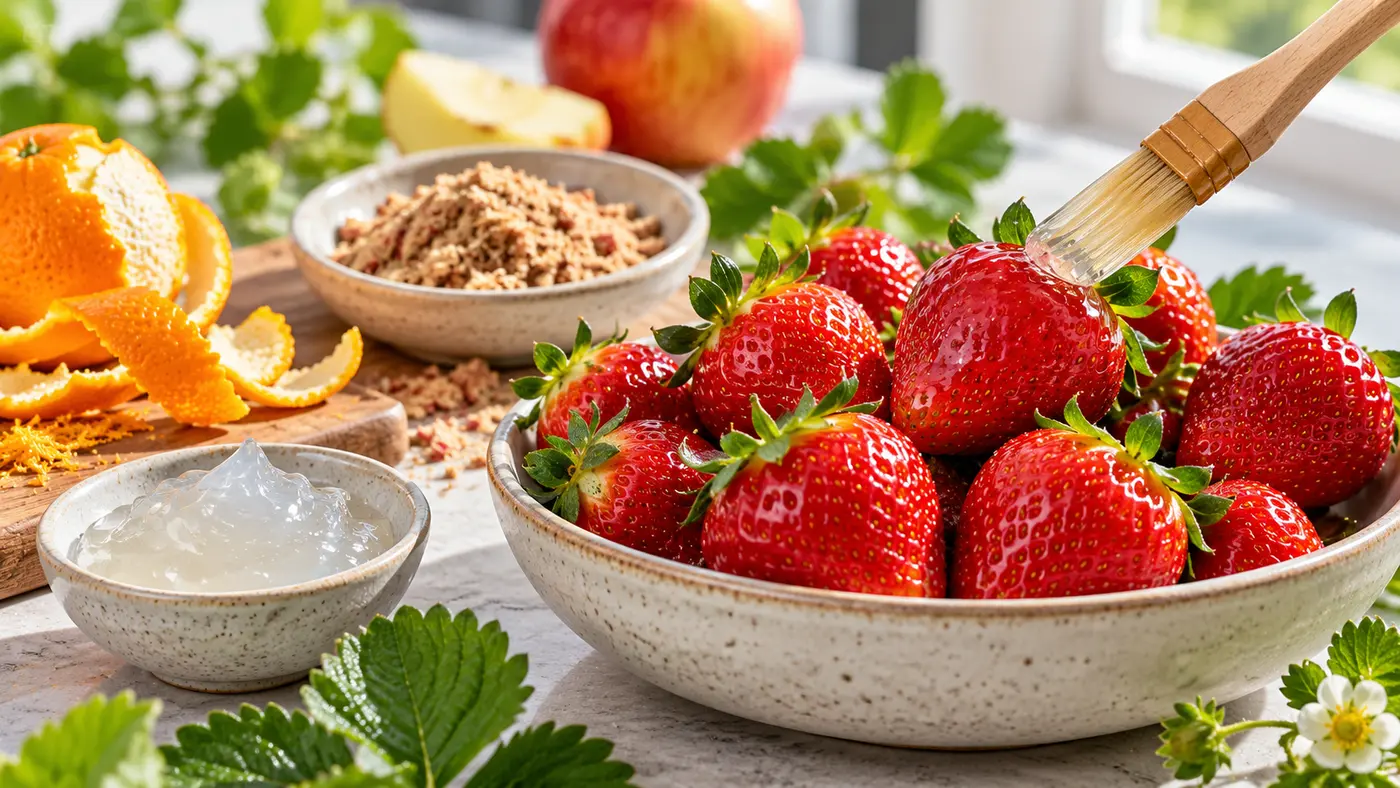
Researchers turned apple and citrus processing leftovers into part of an edible strawberry coating, then found that the treated berries kept their quality four days longer in cold storage.
A strawberry in the fridge is running two races at once: one against moisture loss and another against spoilage. A new food-science experiment gave the fruit an unusually circular sort of help. The protective material included leftovers from processing other fruit.
In a study published online on August 22, 2026, researchers at Technological University Dublin developed a vegan edible coating based on sodium alginate, a seaweed-derived material. They blended it with citrus waste powder, apple pomace powder, and a mixture of carnauba wax and coconut oil. Apple pomace is the pulp, peel, and other material left after juice or cider production, so the formula asked a clever question: could one food stream's leftovers help another food last longer?
The team tested different proportions, then optimized the coating for strength, thickness, and how readily water spread across its surface. The final formulation contained 1.10% citrus waste powder, 1.40% apple pomace powder, and 3.50% carnauba wax and coconut oil solution. Laboratory analysis indicated that the ingredients interacted with the alginate matrix, improving the film's structure, stability, water resistance, ultraviolet-light barrier, and antioxidant activity.
That combination matters because a useful produce coating has several jobs. It must cling without falling apart, slow the movement of moisture, and create a less welcoming route for deterioration. Think rain jacket rather than food vault: the film changes the fruit's immediate surroundings, but it does not make the strawberry indestructible.
When the optimized coating was applied to fresh strawberries stored at 4 C, the fruit retained more colour, internal moisture, and natural sweetness during a 10-day test. Microbial spoilage was delayed, and the coated berries lasted four days longer than the uncoated comparison fruit. Those are results from a controlled study, not a guarantee that every punnet in every fridge would gain exactly four days.
The waste-saving angle is substantial enough to merit attention. The UN Food and Agriculture Organization reported in 2025 that fruits and vegetables had the highest global food-loss rate, at 25.4%, before retail. This experiment tackles that problem twice: it gives apple and citrus processing residues a new job and aims to extend the useful life of another highly perishable fruit.
For now, this is a research prototype, not a do-it-yourself berry dip. The published work does not establish a home recipe or say that shoppers should brush alginate mixtures onto produce. Ordinary food-safety guidance still applies: refrigerate perishable produce at 4 C or below, wash it under running water before eating, skip soap or commercial produce wash, and discard fruit that looks rotten.
The most interesting takeaway is the design logic. Food preservation does not always require a wholly new material. Sometimes yesterday's peel and pulp can become tomorrow's tiny shield, giving the phrase 'fruit protection' a pleasantly literal twist.
Sources
- https://pubmed.ncbi.nlm.nih.gov/42628857/
- https://doi.org/10.1016/j.ijbiomac.2026.154149
- https://www.fao.org/statistics/highlights-archive/highlights-detail/on-the-international-day-of-awareness-of-food-loss-and-waste--learn-how-fao-is-leveraging-data-to-save-food-and-advance-the-2030-agenda/en
- https://www.fda.gov/food/buy-store-serve-safe-food/selecting-and-serving-produce-safely
You may also like these