
Food History
Almond Before Its Time: The Plant Milk in a 1430s Cookbook
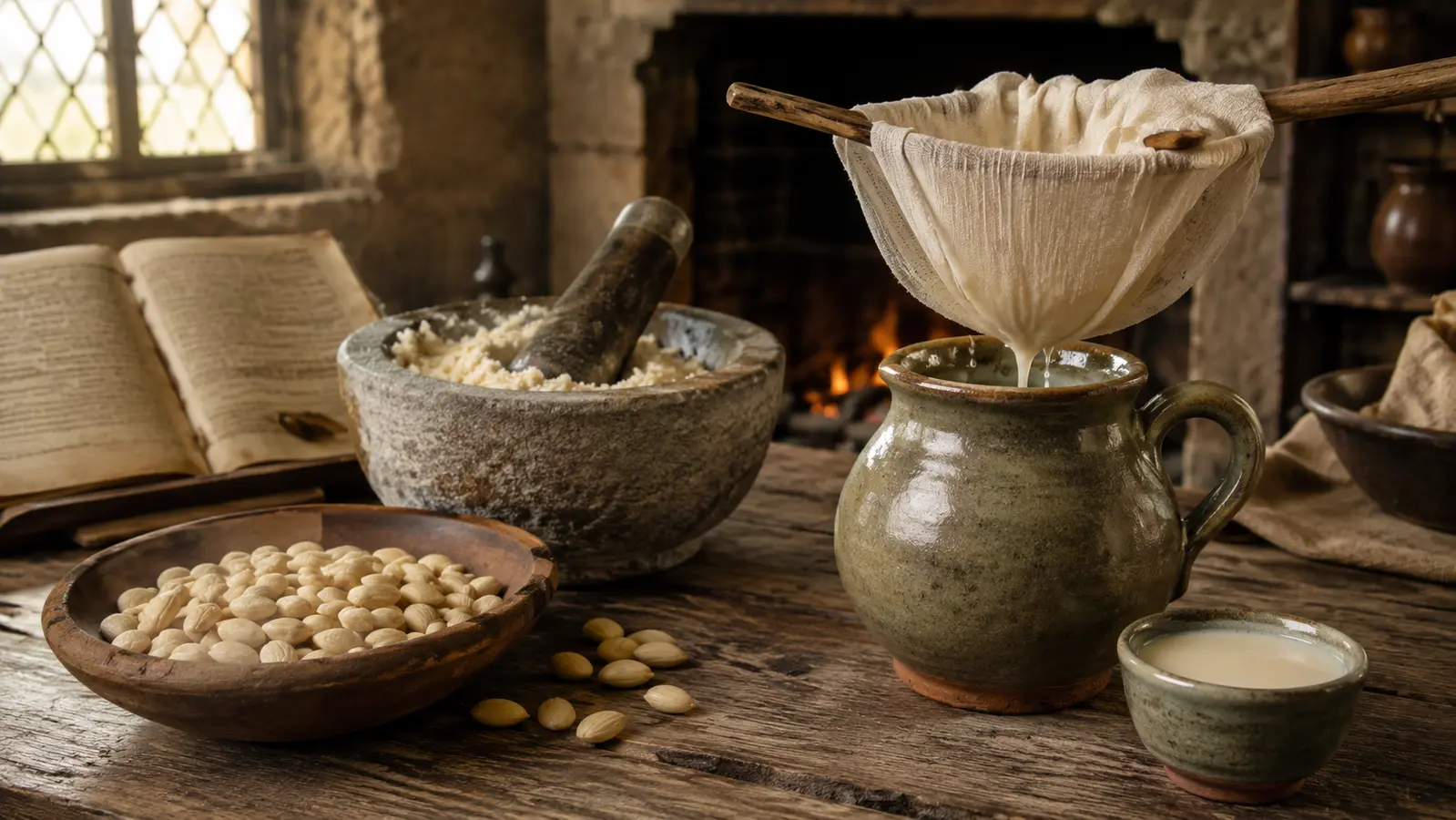
Long before cartons and café frothers, cooks were pounding almonds with water, straining the mixture and putting the resulting “mylke” to remarkably inventive use.
The plant-milk aisle may look thoroughly modern, but the basic idea is older than the printing press. An English parchment cookbook from the 1430s contains almond-milk cookery among its pottages, baked dishes and feast menus—proof that turning nuts into a creamy liquid was already established kitchen knowledge.
The manuscript is known today as Harley MS 279. The British Library catalogues it as a collection of culinary treatises written in Middle English and Latin between 1430 and 1439. Its sections cover varied pottages, sliced dishes, baked foods and menus for feasts. In other words, almond milk was not hiding in a single novelty note; it belonged to a substantial working collection of recipes.
A later published transcription of Harley MS 279 preserves an instruction for cold almond milk. In modern terms, the cook prepared sweetened water, let it cool, pounded blanched almonds and strained—or “drew”—them with the liquid until it was thick enough. The equipment has changed from mortar and cloth to blender and fine sieve, but the underlying method would still be familiar in a kitchen today.
Medieval cooks also had fun with it. University College London highlights a recipe called “Eyroun in lentyn,” or eggs for Lent. The cook emptied and cleaned eggshells, made an almond-milk mixture, coloured part of it yellow with saffron, refilled the shells to resemble whites and yolks, and roasted them. It was culinary illusion long before restaurant tasting menus made that phrase fashionable.
There was a practical reason for the ingredient’s popularity. Many medieval Christian fast days excluded meat, eggs, butter and animal milk, so almond milk could fill useful culinary roles. Food historian Ken Albala told Smithsonian Magazine that it appears in nearly every medieval cookbook. Because dry almonds could be stored and ground when needed, it is reasonable to infer that the ingredient also offered cooks flexibility that fresh dairy could not always provide.
The historical drink was not identical to a modern carton. Recipes could be sweetened and made thicker or thinner for a particular dish, while today’s products may contain added vitamins, minerals, gums or flavourings. The history is fascinating, but it does not make every almond beverage nutritionally interchangeable; the label remains the useful guide.
So the next splash of almond milk in porridge has a surprisingly long family tree. Five centuries ago, someone was already blanching, pounding, straining and asking the timeless kitchen question: is it creamy enough yet?
Sources
- https://searcharchives.bl.uk/catalog/040-002046107
- https://www.ucl.ac.uk/social-historical-sciences/news/2021/apr/boke-kokery-feasting-easter-day
- https://openlibrary.org/books/OL6545094M/Two_fifteenth-century_cookery-books.
- https://www.smithsonianmag.com/history/nut-milks-are-milk-says-almost-every-culture-across-globe-180970008/