
Food Engineering
Crumble Under Pressure: How TVP Gets Its Chew
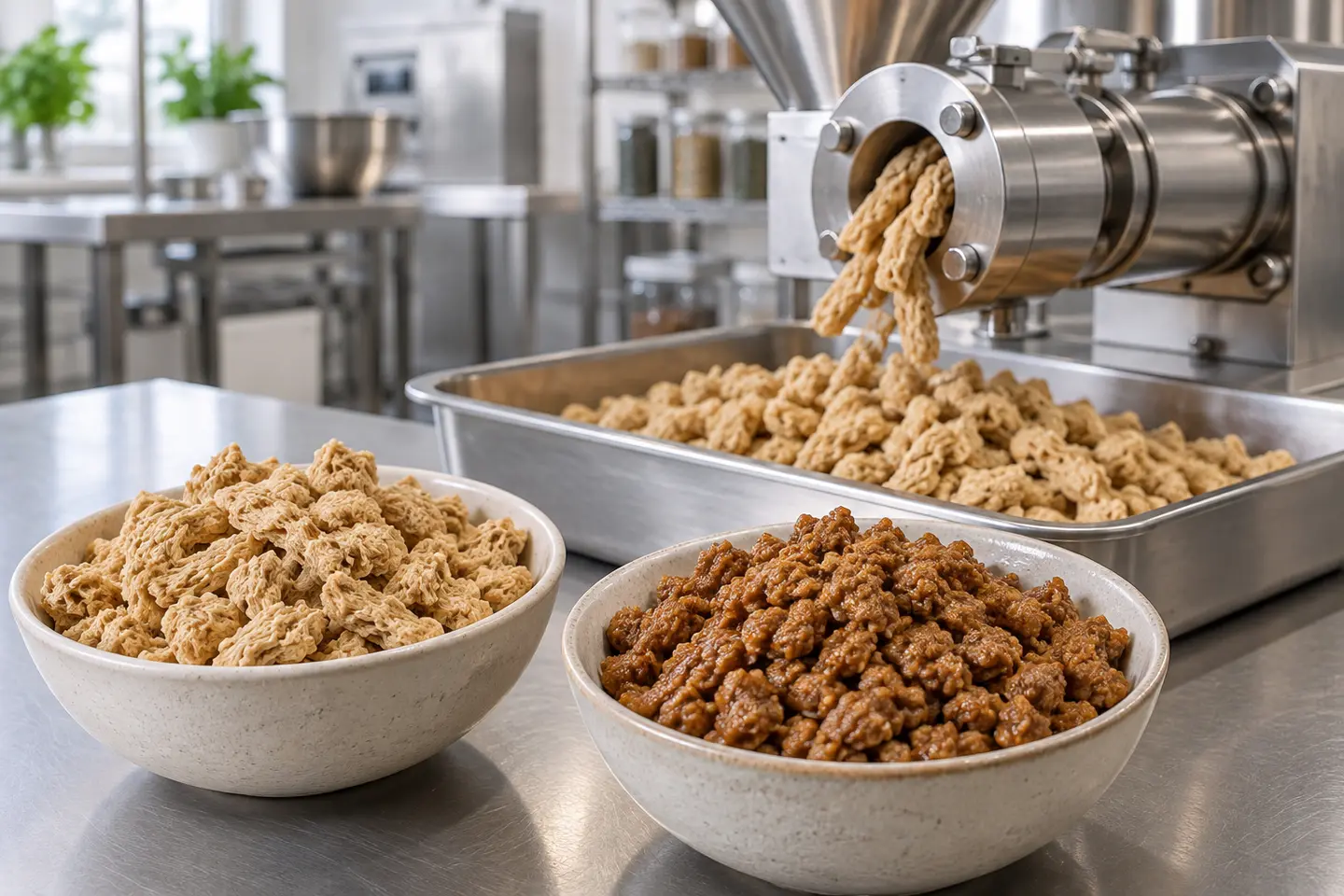
Those dry plant-protein crumbles are the result of a compact factory drama: flour, water, heat and rotating screws build a porous structure that can drink up broth later.
Open a bag of textured vegetable protein and the contents look like tan pebbles, curls or tiny nuggets. Add hot broth and they soften, swell and become pleasantly chewy. The surprising part is that the thirst and the texture were engineered into those dry pieces before they ever reached the pantry.
Textured vegetable protein, often shortened to TVP, is a broad family rather than one exact recipe. Soy is common, but researchers also work with pea, faba bean, wheat and blends that may include starch. The familiar shelf-stable crumbles are usually made by low-moisture extrusion, a process that combines mixing, cooking, shaping and structural rearrangement inside one continuous machine.
An extruder is a heated barrel containing one or two rotating screws. Protein-rich flour and a measured amount of water enter at one end. As the screws turn, they carry the mixture forward while mixing, compressing and shearing it. Heat from the barrel joins the mechanical energy from that movement, turning the loose ingredients into a thick, workable mass.
Inside that mass, proteins do not remain folded exactly as they began. Heat and shear can unfold parts of their structure, while flow brings protein molecules into new arrangements and interactions. Starch, fibre, fat, water and the specific protein source all influence the result. This is why an extruder is not simply a powerful pasta maker: it is also a tightly controlled texture workshop.
The exit provides the dry crumble with its most useful clue. Under low-moisture conditions, the hot mixture is pushed through a die and suddenly meets normal air pressure. Some water flashes into vapour, helping the piece expand and form small internal spaces. After cutting and drying, that porous architecture is ready to take water back in.
A controlled soy-protein study published in Food Science and Biotechnology showed how sensitive that architecture can be. Changing die temperature and screw speed altered expansion, density and water absorption. More heat or speed did not improve every property forever; extreme conditions could produce less desirable structure. The useful chew comes from a process window, not from turning every dial to maximum.
That helps explain why two bags of dry crumbles may ask for different soaking times. A study of commercial textured vegetable proteins found meaningful differences in their water absorption, cooking behaviour and texture. Shape matters, but so do the protein blend and the microscopic spaces created during processing. Package directions are therefore useful engineering notes, not decorative suggestions.
There is also a wetter branch of the family. High-moisture extrusion uses much more water and commonly adds a cooling die that lets the hot protein structure set without puffing dramatically at the exit. The result can be a dense, layered piece sold chilled or frozen. Dry TVP granules and a refrigerated fibrous strip may share an extruder in their family tree, yet they are designed to behave differently in the kitchen.
The ingredient possibilities are expanding too. A 2025 study produced low-moisture textured proteins from faba bean ingredients and tested how processing conditions affected the finished pieces. It is a reminder that extrusion is a method, not a guarantee of one flavour, nutrition profile or bite. Each crop and formula needs its own settings.
At home, let the structure do the work. Rehydrate dry TVP with the amount and temperature of liquid named on the package, then taste before deciding whether to drain or squeeze it. Broth carries seasoning into those pores, while a short sauté after soaking can add browned edges. The hydrated crumbles can then join chili, pasta sauce, tacos or stuffed vegetables.
So the next time dry TVP quietly doubles in personality, picture the journey hidden inside each piece. Rotating screws supplied movement, heat loosened old protein arrangements, pressure shaped the mass and a quick exit left behind room for dinner. That humble crumble did not merely survive the squeeze. It got its chew from it.