
Food Craft
Seaweed, Paper, Scissors: How Nori Becomes a Sheet
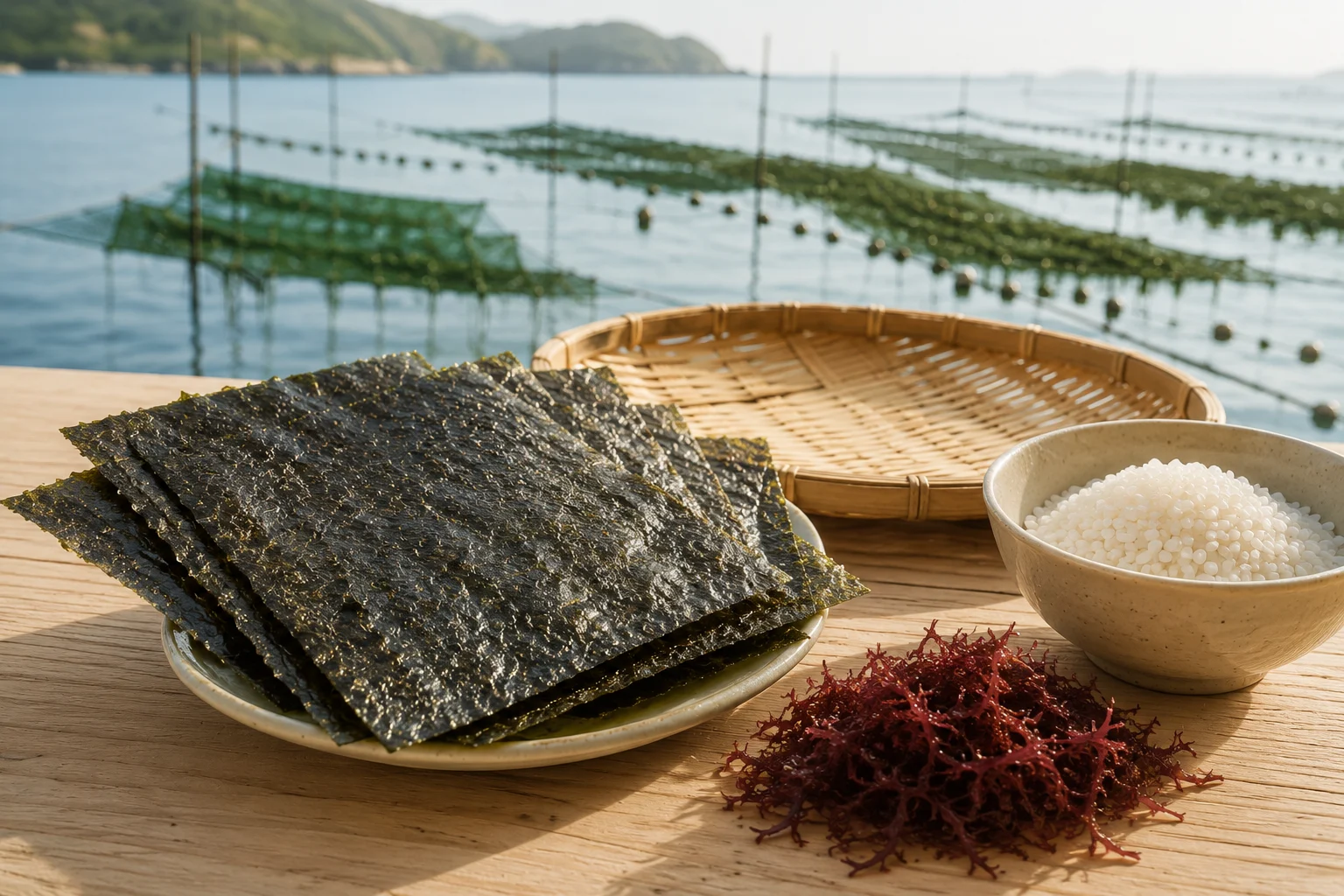
Nori does not grow in tidy snack-sized squares. Its trip from delicate red seaweed to crisp green sheet borrows a clever idea from papermaking.
Open a packet of nori and the pieces look almost engineered: thin, flat and ready to wrap around rice. The fun fact is that nori does not grow that way. It begins as soft blades of edible red seaweed, commonly from species historically grouped under the name Porphyra and now often classified as Pyropia or Neopyropia.
Nori farming starts with microscopic life stages that are raised under controlled conditions. The young seaweed is seeded onto nets, which are then moved to coastal growing areas. Depending on the farm, those nets may be fixed between posts, partly floating or fully floating. The blades grow while attached to the net, drawing what they need from the surrounding seawater and sunlight rather than from soil.
The first harvest can begin after roughly 40 to 50 days of growth for commonly cultivated species, according to the UN Food and Agriculture Organization. Farmers can then harvest the same crop repeatedly during its growing season. The fresh seaweed is highly perishable, so processing follows quickly.
Here is where the square-sheet magic happens. The harvested seaweed is sorted and washed, first to clean it and then with fresh water. It is chopped into small pieces and mixed into a slurry. That slurry is spread in a thin, even layer on a screen or frame, rather like pulp in traditional papermaking. Water drains away, the layer is pressed and dried, and thousands of small fragments lock together as one delicate sheet.
The FAO describes a traditional dried sheet as about 21 by 19 centimetres and only around 3 grams. Modern production is more mechanized, but the basic sequence remains recognizable: wash, chop, form, dehydrate, dry, grade and pack. The result is dried nori, sometimes called hoshi nori.
Many sheets sold for wrapping and snacking are toasted after drying. Heat drives off a little remaining moisture, makes the sheet crisper and develops its roasted aroma. Seasoned versions may also be brushed with oil or flavourings, so label readers who want a simple vegan option can look for plain nori or check added ingredients individually.
At home, keep nori tightly sealed and dry because humidity quickly steals its snap. If a sheet softens, a few seconds over gentle heat or a brief visit to a low oven can often restore some crispness. Crumble it over noodles, rice bowls and soups, cut it into snack strips, or use the whole sheet as the world’s tastiest piece of edible wrapping paper.