
Food Processing
Dry Another Day: How Freeze-Drying Lets Ice Skip the Puddle
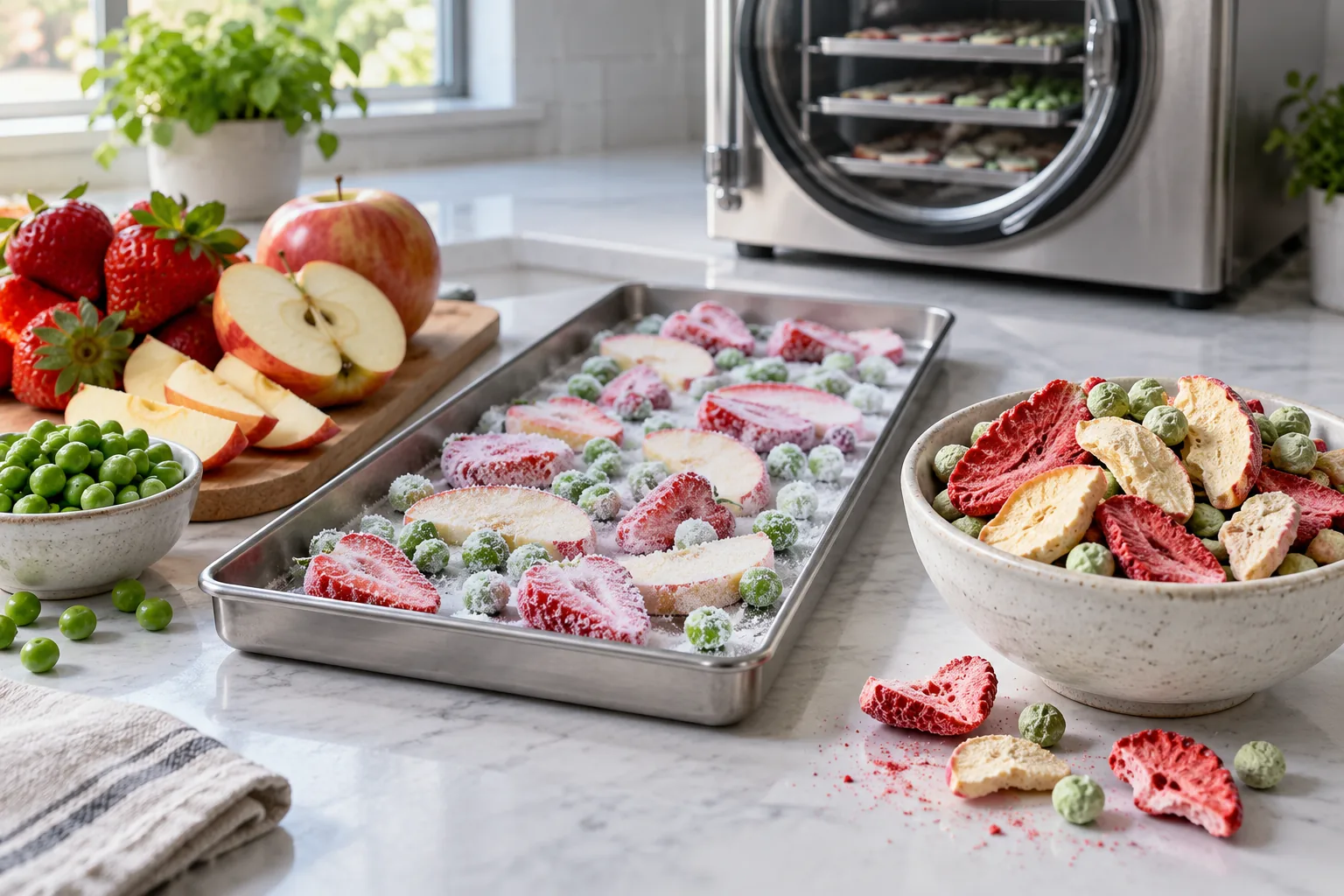
Freeze-dried food gets its airy crunch because frozen water leaves as vapour under low pressure, creating a network of tiny spaces without first becoming a puddle.
Pick up a freeze-dried strawberry and it feels almost suspiciously light. Bite it and the fruit snaps, then seems to dissolve as it meets moisture in your mouth. This is not ordinary freezing followed by a long wait on the counter. Freeze-drying, also called lyophilization, gives water a carefully controlled exit route that changes the food's weight, texture and storage behaviour.
The process begins by freezing the food solid. Water inside the fruit, vegetable or prepared dish becomes ice, while sugars, acids, fibres and other solids remain around those crystals. This first stage quietly draws the blueprint for the dried structure because the size and location of the ice crystals help determine the spaces that will remain later. A 2020 review of freeze-dried foods notes that freezing conditions can therefore influence porosity, drying time and final texture.
Next, the frozen food enters a low-pressure chamber. The pressure is reduced and a controlled amount of heat supplies the energy needed for sublimation, the change from solid ice directly into water vapour. The ice does not melt into liquid first. Vapour travels away from the food and freezes onto a colder condenser elsewhere in the machine. The U.S. Food and Drug Administration describes this as primary drying, followed by secondary drying that removes more tightly bound moisture by desorption.
That disappearing ice explains the theatrical crunch. Each crystal once occupied real space. When it leaves as vapour, it can leave a tiny tunnel or pocket instead of allowing the surrounding material to shrink into a dense, chewy piece. The result is often a light, porous structure that takes up water readily. It is also fragile, which is why a bag of freeze-dried berries can contain both beautiful slices and a surprisingly useful layer of fruit dust.
Not every food dries into the same kind of crispness. A 2022 Food Chemistry study comparing freeze-dried fruit and vegetable cubes found that cell-wall polysaccharides and smaller sugars helped determine texture and how readily the pieces attracted moisture from the air. Fructose was especially associated with greater hygroscopicity, the tendency to absorb water. The practical translation is that strawberries, apples and carrots do not leave the chamber wearing identical crunch coats.
Removing available water slows the growth of microorganisms, but freeze-drying is not a sterilizing step. Utah State University Extension's 2026 food-safety guide warns that bacteria can survive the process and become active again if conditions improve, including after rehydration. The safe result depends on suitable food, clean handling, complete drying and protective packaging. A home freeze-dryer is sophisticated preservation equipment, not a magic eraser for unsafe ingredients.
Packaging matters because the new porous structure is excellent at welcoming moisture back. Once humidity enters, crisp pieces can soften and their water activity can rise. Water activity is not simply total moisture; it describes how much water is available for microbial and chemical activity. FDA guidance explains that controlling water activity inhibits microbial growth. For a purchased fruit snack, follow the label, seal the package promptly, use a dry utensil and keep it away from steam above the kettle or stovetop.
Freeze-drying also deserves a little realism. Low processing temperatures can help preserve shape, colour, flavour and some heat-sensitive compounds, but retention varies with the food, pretreatment, process and storage. Reviews also point to long drying times, specialized equipment and substantial energy use. That makes it a useful high-quality preservation method, not automatically the best environmental or nutritional answer for every ingredient.
In a vegan kitchen, the dry texture creates some playful options. Crush freeze-dried raspberries into a naturally vivid powder for frosting, fold crisp apple pieces into granola just before serving, or crumble peas over soup as a last-second garnish. Because the water is gone, flavour and sugars are concentrated by weight, so compare equal serving sizes rather than assuming a feather-light handful is nutritionally identical to the same weight of fresh fruit. Check flavoured products for added sweeteners and other ingredients.
So the great freeze-drying trick is not cold alone. It is the combination of freezing, low pressure, careful heat and a cold trap that persuades ice to leave without becoming liquid. The fruit keeps the tunnels, the package keeps out humidity, and your snack gets to make far more noise than something so light reasonably should.
Sources
- https://extension.usu.edu/foodsafety/research/can-i-freeze-dry-that-a-practical-guide-to-safe-and-effective-freeze-drying
- https://pmc.ncbi.nlm.nih.gov/articles/PMC7603155/
- https://pubmed.ncbi.nlm.nih.gov/35777212/
- https://www.fda.gov/inspections-compliance-enforcement-and-criminal-investigations/inspection-guides/lyophilization-parenteral-793
- https://www.fda.gov/inspections-compliance-enforcement-and-criminal-investigations/inspection-technical-guides/water-activity-aw-foods