
Ingredient Know-How
Date Expectations: The Fruit That Can Dry on the Tree
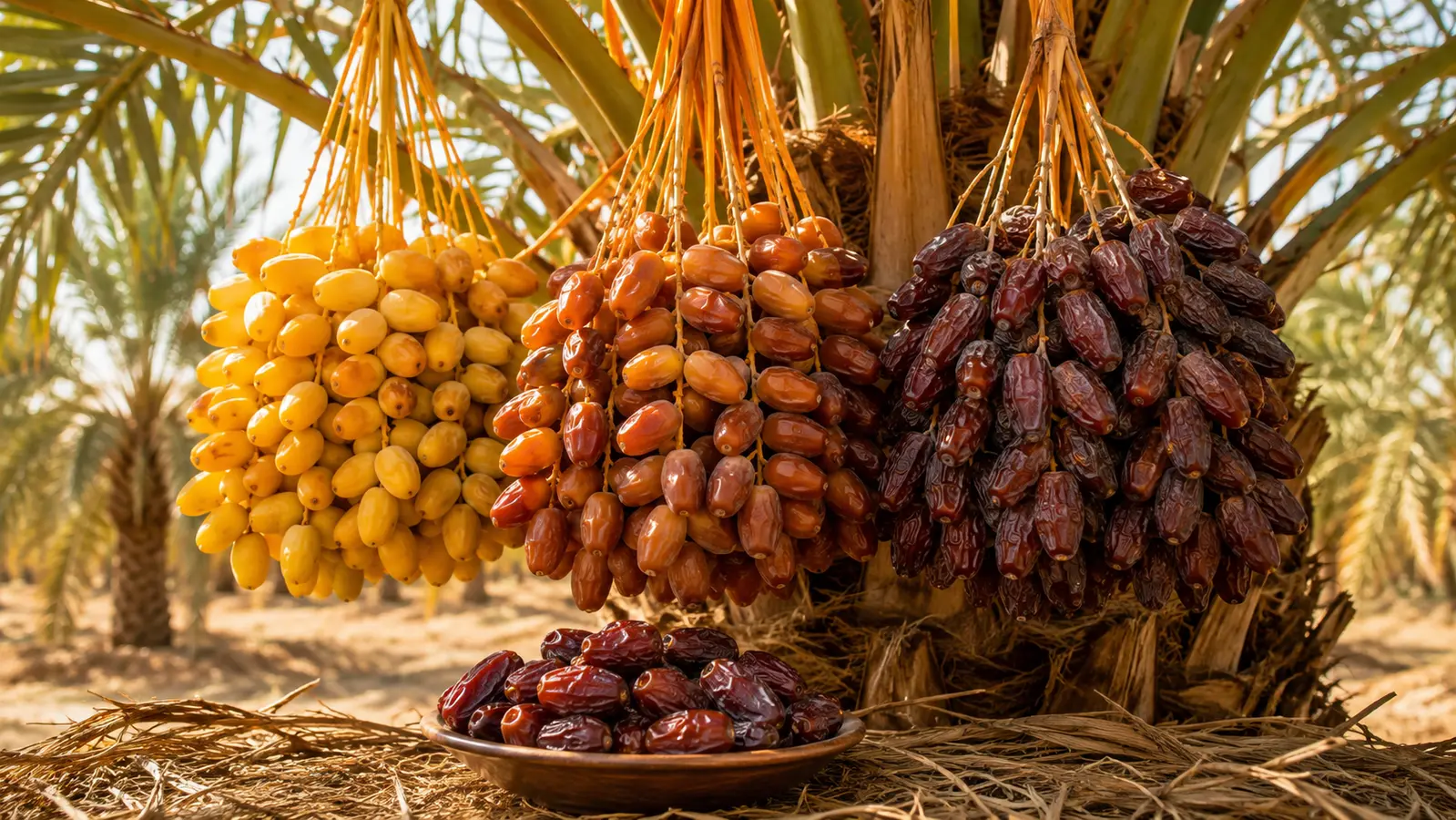
Dates do not leap from green fruit to wrinkled pantry snack in one step. They pass through a remarkable series of textures, colours and moisture levels right on the palm.
A supermarket date looks like dried fruit, but its path is unusual. Many varieties do a large part of their ripening and drying while still hanging in heavy clusters on the date palm.
Growers commonly describe several development stages. After the early green kimri stage, dates reach khalal, when the fruit is full-sized, crisp and often yellow or red. Some varieties, including Barhi, can be enjoyed at this firm stage, although many are still noticeably astringent.
Next comes rutab. Browning usually begins at the tip and spreads as the fruit softens, loses moisture and becomes sweeter. The Food and Agriculture Organization notes that moisture can fall to roughly 35 percent at this stage, producing the tender fresh dates sold in some markets.
Leave suitable varieties on the palm longer in a hot, dry climate and they can reach tamr. The fruit becomes darker, denser and more wrinkled as moisture falls further. FAO guidance describes tamr dates as self-preserving at sufficiently low moisture, although careful handling and storage are still needed to prevent insects, moisture uptake and quality loss.
This is why the date aisle contains such different personalities. A fresh khalal date can be crisp like an apple, rutab can be soft and almost jammy, and tamr ranges from pliable to firm. Variety, climate and harvest timing all help determine which version reaches the table.
Not every date finishes drying on the tree. Rain and humidity can damage ripening fruit, and some harvested dates require additional controlled drying. UC Davis postharvest guidance recommends reducing moisture to help limit molds and yeasts, while also controlling temperature and humidity during storage.
So the familiar brown date is not simply a fresh fruit run through a generic dehydrator. It is often the final chapter of a carefully managed ripening sequence, with sweetness concentrating as water leaves and the fruit gradually transforms on the palm.