Food History
Cube Roots: How Bouillon Shrunk the Stockpot
Long before today’s vegan stock cubes, one Swiss miller experimented with pea and bean meals on the road to a pocket-size pantry shortcut.
A stock cube is a wonderfully bossy little object. Drop one into hot water and it announces a whole pot’s worth of savoury ambition, despite being barely larger than a sugar cube. The trick is concentration: instead of storing a ready-made broth’s water, a cube keeps a dry, compact mixture that can be reconstituted when the kettle is on.
Its route to the pantry runs through a Swiss flour mill. In the early 1880s, miller Julius Maggi began developing foods based on legumes such as peas and beans. The Swiss National Museum describes his experiments with legume flour that could become soup when water was added. The idea was practical, even if the first versions did not immediately win over shoppers.
Maggi kept tinkering. In 1886, his business introduced ready-to-cook soup and a concentrated liquid seasoning. The familiar pressed bouillon format followed in 1908, according to Nestlé’s historical timeline. The cube did not invent the ancient idea of concentrated broth, but it gave the industrial version a remarkably tidy shape: measured, shelf-friendly and ready to travel from wrapper to saucepan.
That shape works because water is postponed. Today’s international Codex standard describes dehydrated bouillon as a dry product that becomes broth after it is reconstituted with water, with or without heating. Cubes, powders, pastes and concentrated liquids can all perform the same broad pantry job while using different formulations.
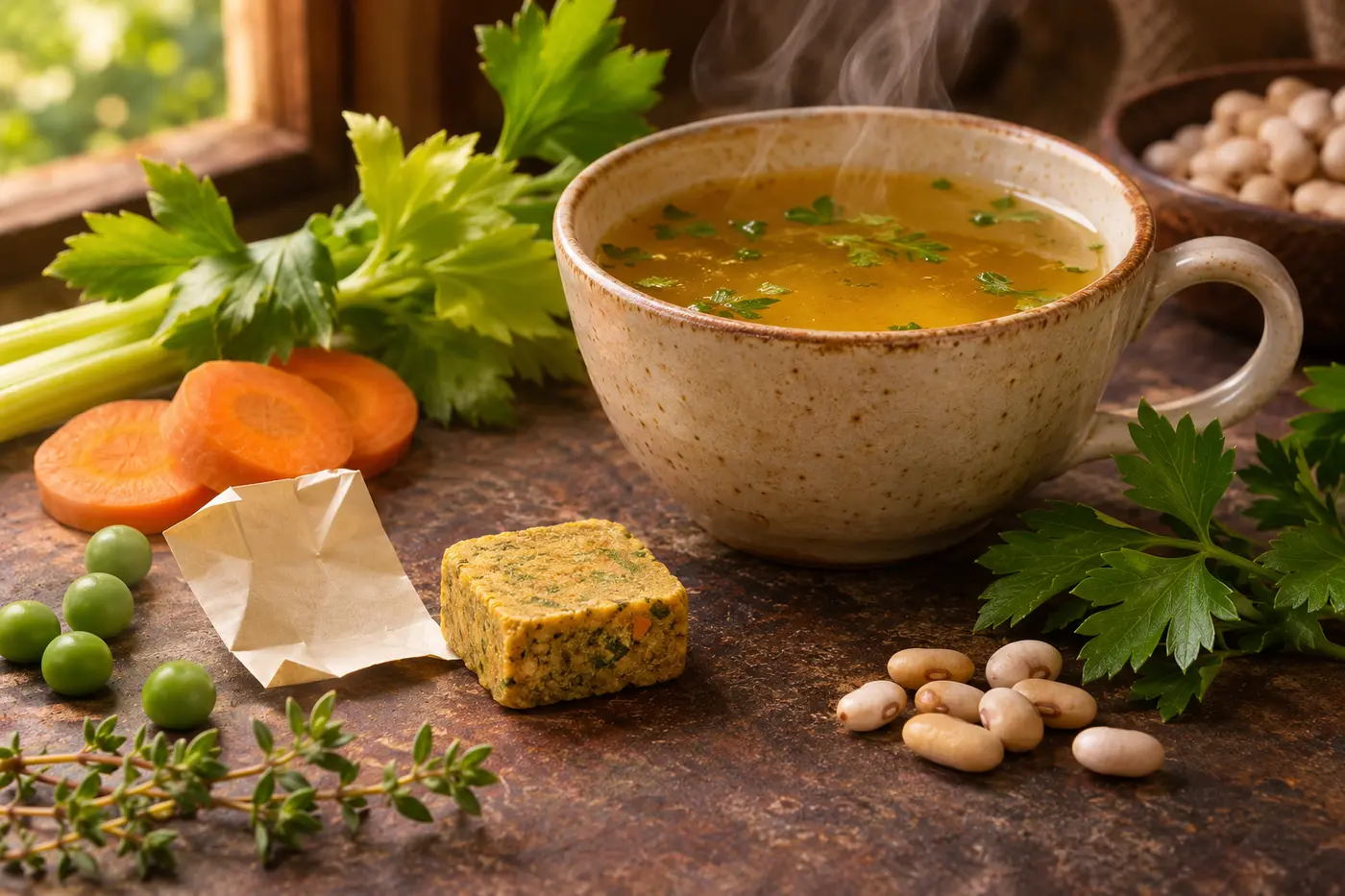
A modern vegan cube may combine salt, dried vegetables, starch, fat, herbs, spices, yeast extract or other flavouring ingredients. Recipes vary widely, so “bouillon” does not name one fixed formula, and “vegetable” on the front does not list everything inside. For a vegan choice, read the full ingredient list and allergen statement rather than judging by the picture of a carrot.
The directions matter too. Nutrition information may describe a portion of dry cube, a prepared cup or another serving size, depending on the label. The amount of water changes concentration but does not remove the sodium supplied by the cube. Comparing products is easiest when the serving bases match and the suggested dilution is included in the calculation.
In the kitchen, treat the cube as a concentrated seasoning rather than an order. Start with less than the package suggests when a recipe already contains salty ingredients such as miso, soy sauce or canned beans, then taste after everything has simmered together. Crumbling a cube into a dry pan can create stubborn salty pockets; dissolving it in hot water first spreads the flavour more evenly.
The stock cube’s family tree therefore has an unexpectedly leguminous branch: pea and bean experiments helped set Julius Maggi on the path toward concentrated soups, seasoning and, eventually, a pressed cube. More than a century later, the format still performs the same small feat of pantry geometry—making a stockpot’s promise fit beneath a wrapper.
Sources
- https://blog.nationalmuseum.ch/2017/06/der-suppen-alchemist/
- https://www.nestle.com/brands/food-snacks/maggi
- https://www.nestle.com/sites/default/files/asset-library/documents/library/documents/fact_sheets/nestle-research-150-years.pdf
- https://www.fao.org/fao-who-codexalimentarius/sh-proxy/en/?lnk=1&url=https%253A%252F%252Fworkspace.fao.org%252Fsites%252Fcodex%252FStandards%252FCXS%2B117-1981%252FCXS_117e.pdf
- https://www.fao.org/gsfaonline/foods/details.html?id=198
You may also like these