Kitchen Troubleshooting
Crowd Control: Why a Packed Sheet Pan Won’t Brown
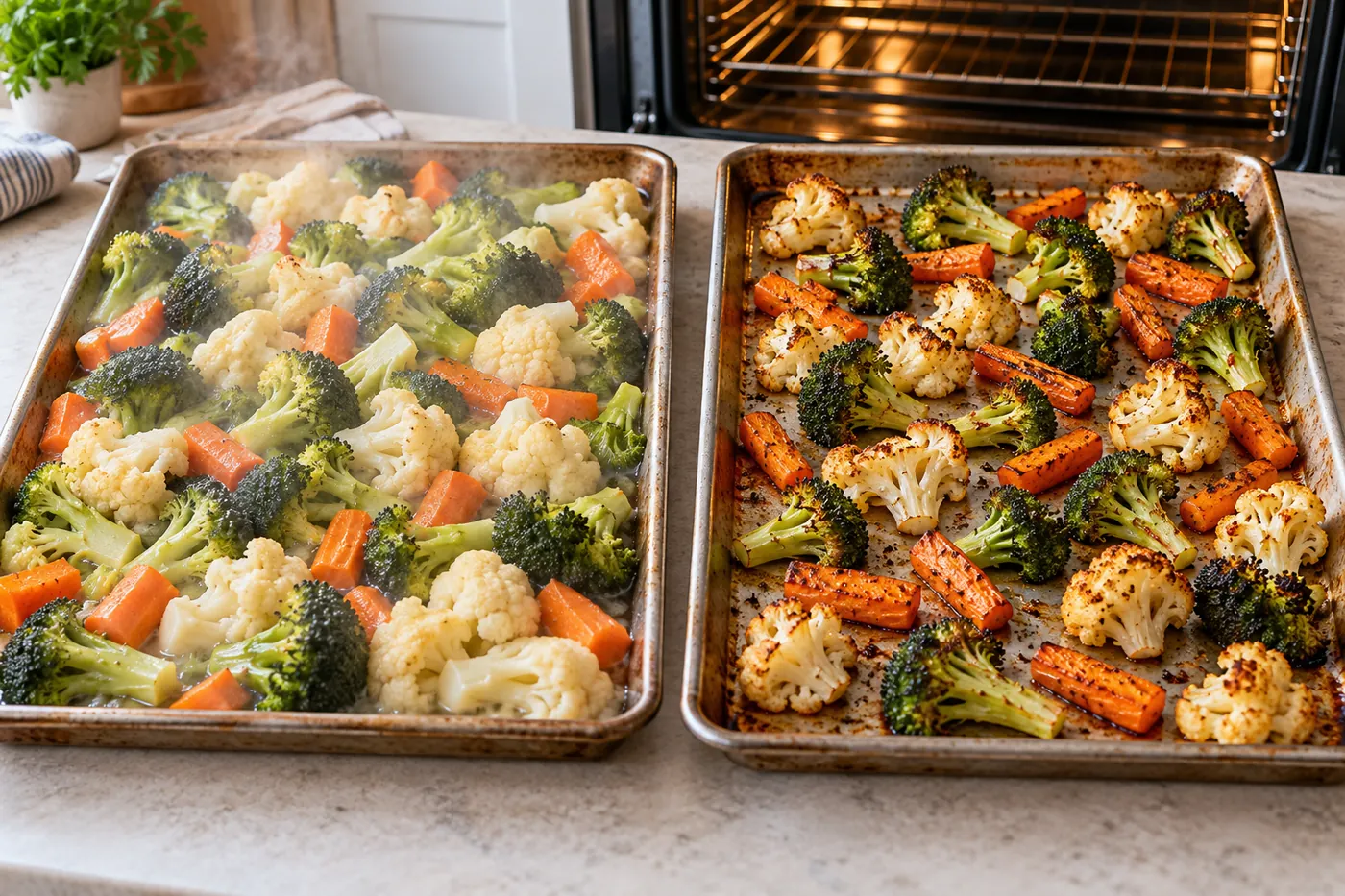
A crowded tray can turn roasting into accidental steaming. The fix comes down to surface moisture, room for vapour to escape and enough steady heat for browning to begin.
Roasted vegetables should have crisp edges and concentrated flavour, yet an overloaded tray can emerge pale and limp. The oven was hot. The timer worked. The missing ingredient was not another spice. It was elbow room.
Browning is not an oven colour setting. One important pathway is the Maillard reaction, which begins when amino compounds and reducing sugars react. A 2025 review in Foods notes that its pace depends on temperature, time, pH and water activity. Caramelization can contribute to colour and flavour too, but it is a different family of sugar reactions.
Fresh vegetables carry plenty of water. Before a wet surface can spend much time in dry, browning-friendly conditions, heat must warm and evaporate that moisture. Evaporation takes energy away from the surface. NC State Extension explains the same physical principle in its guide to vacuum cooling: water needs heat energy to change into vapour, and the produce cools as that energy is used.
Now crowd the pan. Steam leaving one broccoli floret meets steam leaving the next. The humid air has a harder time moving away, pieces touch, and droplets can collect in the tray. The vegetables keep cooking, but the pan behaves more like a shallow steamer while those wet surfaces wait for drier, hotter conditions.
Cornell Cooperative Extension gives the useful kitchen version: dry vegetables well after washing and split a crowded batch between two sheets to prevent steaming instead of roasting. It does not mean every touching piece is doomed. It means spacing shifts the odds toward faster moisture escape and more exposed surface.
More oil cannot manufacture empty space. A thin coating helps seasoning stick and improves contact between food and hot metal, but extra oil does not remove the water trapped around a heap of florets. It can simply leave the finished vegetables greasy.
Three levers do most of the work: dry surfaces, breathing room and steady heat. Pat washed vegetables dry, cut them into reasonably even pieces, let the oven preheat fully and arrange everything in one layer with visible gaps. A sturdy rimmed sheet pan gives hot air and hot metal room to work together.
Mixed trays need a little matchmaking. Watery mushrooms or zucchini can release moisture quickly, while dense carrots or potatoes usually need more time. Use separate pans, or add the faster, wetter vegetables later, so one ingredient does not set the humidity and timing for everyone else.
For a quick kitchen check, divide one head of cauliflower between two pans. Pack one tightly and spread the other in a roomy layer. Use the same oil, seasoning, rack position and roasting time, then compare pooled liquid, edge colour and tenderness. It is a small test with a very visible result.
If a tray is already crowded, divide it onto a second sheet as soon as you notice pooling liquid, then return both pans to the oven. Browning is not about burning dinner or chasing the darkest possible crust. It is about giving surface moisture somewhere to go so heat can do a different job. Your vegetables do not need total privacy, but they do need a little personal pan space.
Sources
- https://pmc.ncbi.nlm.nih.gov/articles/PMC12154226/
- https://blogs.cornell.edu/efnep-schoharie-otsego/2020/08/12/intensify-the-taste/
- https://content.ces.ncsu.edu/introduction-to-the-postharvest-engineering-for-fresh-fruits-and-vegetables/3d-vacuum-cooling
- https://www.ift.org/food-technology-magazine/water-activity-and-food-quality
You may also like these