
Ingredient botany
Cashew Outside the Box: The Nut That Hangs Under a Fruit
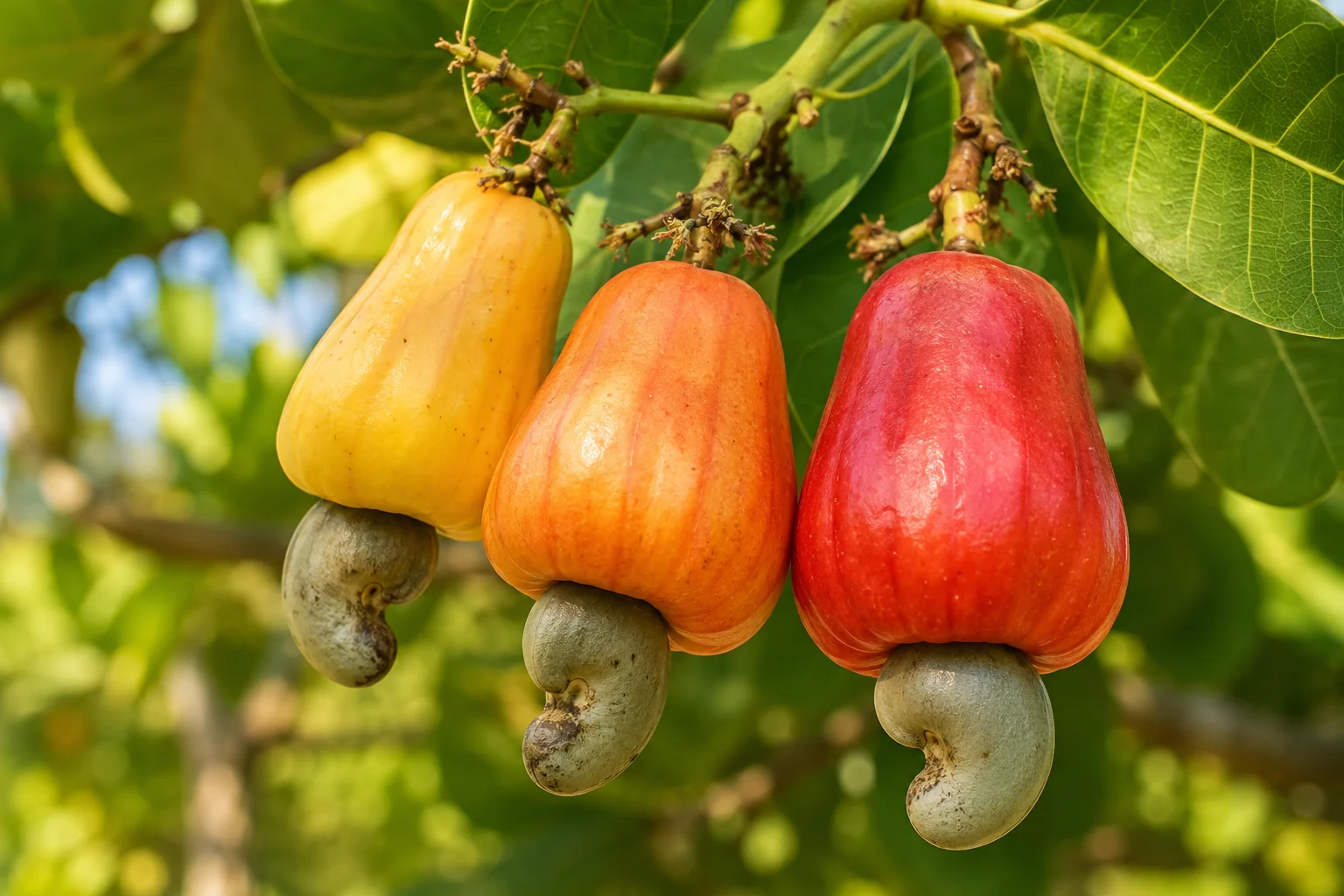
A cashew does not hide inside a fruit like an ordinary seed. It dangles from the bottom of a colourful cashew apple in one of the snack aisle’s strangest origin stories.
Picture a bright red or yellow fruit shaped a little like a pear. Now attach one curved grey-green shell to its bottom, as if the fruit grew a tiny comma. That is a cashew on the tree, and the familiar creamy kernel is tucked inside that dangling shell.
The colourful part is called the cashew apple, but botanically it is not the tree’s true fruit. It develops from an enlarged, fleshy flower stalk, often described as a false fruit or pseudo-fruit. The kidney-shaped structure hanging underneath is the true fruit, and the edible cashew kernel is its seed.
This also explains why cashews can seem surprisingly precious. A cashew apple normally carries just one shell and therefore one kernel. A generous handful of cashews represents a whole collection of individual fruits, each harvested and processed separately.
The cashew apple is edible too. It is juicy, sweet-tart and often described as astringent. In places where cashew trees grow, the apples can become juice, preserves, syrups, vinegar and other foods. They are delicate and highly perishable, which helps explain why shoppers far from cashew-growing regions usually meet the kernel but not its colourful companion.
The shell is the part that demands respect. Between its layers is cashew nut shell liquid, an oily material that can irritate and damage skin. Cashews therefore need careful commercial shelling and heat processing. A package labelled raw refers to a cashew that has not been roasted for flavour in the usual way, not a seed casually cracked straight from a freshly picked shell.
Cashew trees, known botanically as Anacardium occidentale, are native to tropical parts of the Americas and are now grown widely in warm regions. The evergreen trees produce flowers first, followed by the unusual two-part combination of apple and shell.
So the next time cashews turn a sauce creamy or add crunch to a stir-fry, remember their improbable starting point. Each curved kernel once hung outside a colourful fruit, looking less like a hidden seed and more like the fruit’s tiny punctuation mark.