Coffee Science
Pour Relations: Why Plant Milk Sometimes Splits in Coffee
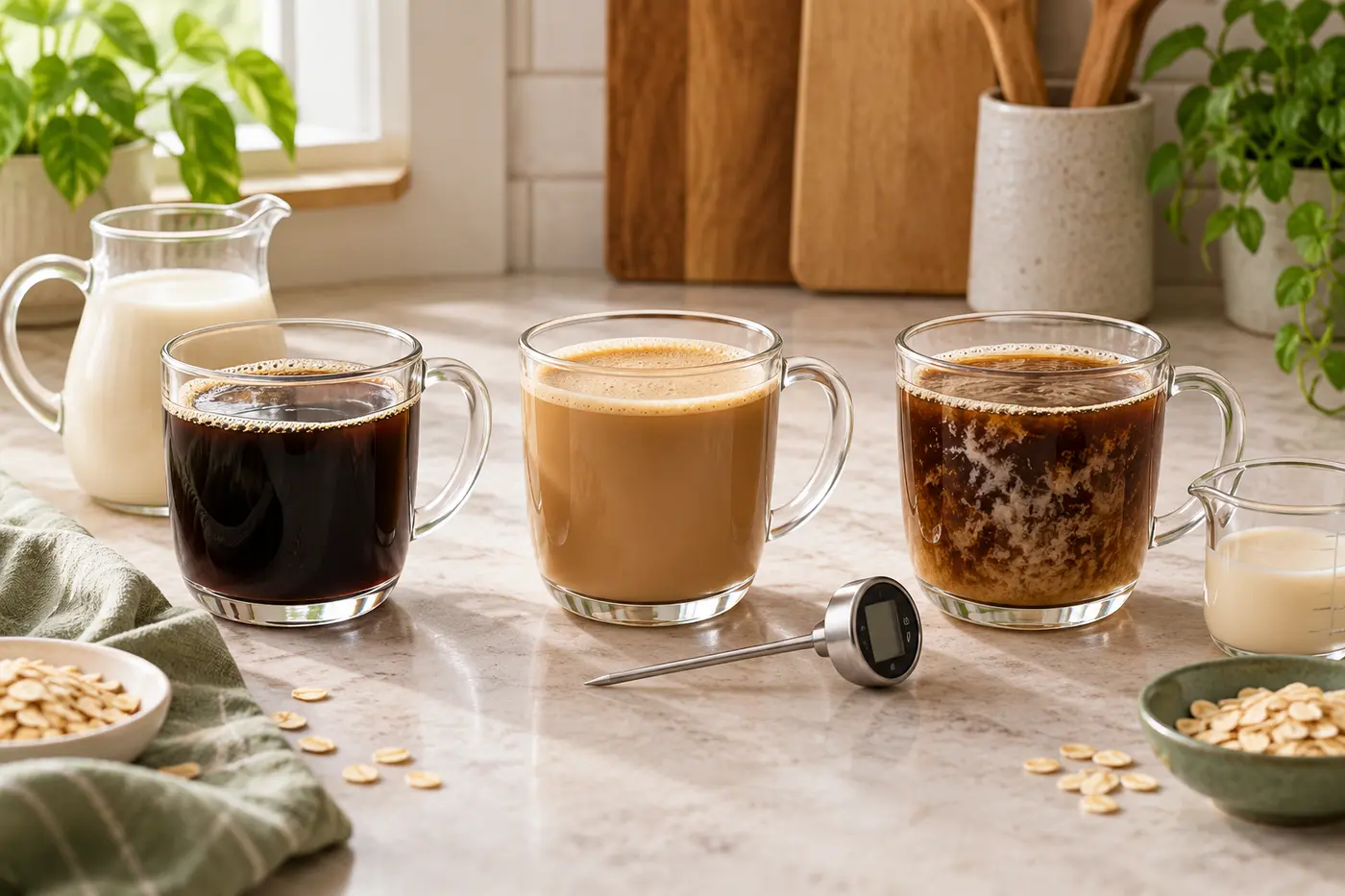
Hot, acidic coffee can turn a smooth plant-milk pour grainy when suspended proteins lose their comfortable spacing. A simple three-cup test can reveal which dial matters in your mug.
You pour a perfectly smooth plant drink into coffee and suddenly see tiny pale flecks drifting through the mug. The same carton behaved yesterday, so what changed? Usually, the useful question is not whether coffee and plant milk can get along. It is which combination of heat, acidity, concentration and formulation pushed this particular cup into separation.
A plant-based drink is a carefully arranged mixture of water, small oil droplets, proteins, carbohydrates and minerals. Those particles stay dispersed when the forces around them keep them from clumping. Coffee changes that neighbourhood. It contributes acids and dissolved compounds, while the heat changes how quickly particles move and interact. When the balance tips, proteins and other suspended material can gather into clusters large enough to see.
A 2019 University of Strathclyde study mapped this behaviour using one unsweetened long-life soy drink mixed with instant coffee. At higher temperatures, the researchers observed a two-phase region where the mixture separated. At lower temperatures it remained in one phase. In their model system, cooling the mixture or increasing the proportion of soy drink could even return a separated mixture to a single phase. That does not make every carton identical, but it shows why one universal coffee rule is unlikely to work.
Think of the mug as having three dials rather than one culprit. The first dial is temperature. If a drink splits, repeat the cup after letting the coffee stand for two or three minutes, and do not boil the plant milk. A slightly cooler trial changes one variable without changing the beans, carton or recipe.
The second dial is proportion and mixing. A small splash receives a concentrated hit of hot, acidic coffee. Try starting with a more generous amount of plant milk, then pour the coffee into it slowly while stirring. This is not a magic order for every product, but it is a controlled way to reduce abrupt local changes and test whether concentration is the deciding factor in your cup.
The third dial is formulation. A 2025 review of barista-style plant drinks describes how protein, fat, total solids, acidity and heat treatment all influence performance in coffee. Some products also use acidity regulators or stabilizers to help particles stay apart. A separate 2025 study on soy drinks and pectin found that ingredient interactions can meaningfully change resistance to curdling in acidic coffee conditions. In other words, the word ‘barista’ is not only about foam; the recipe inside the carton may be built for stability too.
Here is a tidy kitchen test. Make one batch of coffee and divide it among three cups. In cup one, use your usual method. For cup two, let the coffee cool briefly before combining. For cup three, use a larger plant-milk proportion and add the coffee gradually to the milk. Keep the amounts written down, because memory is a surprisingly poor lab notebook before breakfast.
If temperature fixes the second cup, you have a heat-sensitive pairing. If the third cup stays smooth, proportion or mixing speed may be the bigger lever. If all three separate, try the same coffee with a barista-formulated version of the plant drink. If none separate on the second attempt, shake the carton before the next test so settled solids are evenly redistributed.
Different coffee beans, roast levels, brewing methods and plant-drink recipes can move the result, so a win with one combination does not guarantee every future mug. It also means a split cup is not proof that an entire category of plant milk is hopeless. You may simply have found a narrow mismatch between two products under one set of conditions.
The practical lesson is pleasantly small: change one dial at a time. Cooler coffee, a different ratio or a coffee-ready formulation can turn an unpredictable morning pour into a repeatable one, with no chemistry degree required beside the kettle.
Sources
You may also like these