Food Safety Myth-Busting
Floor It? Four Variables Beat the Five-Second Rule
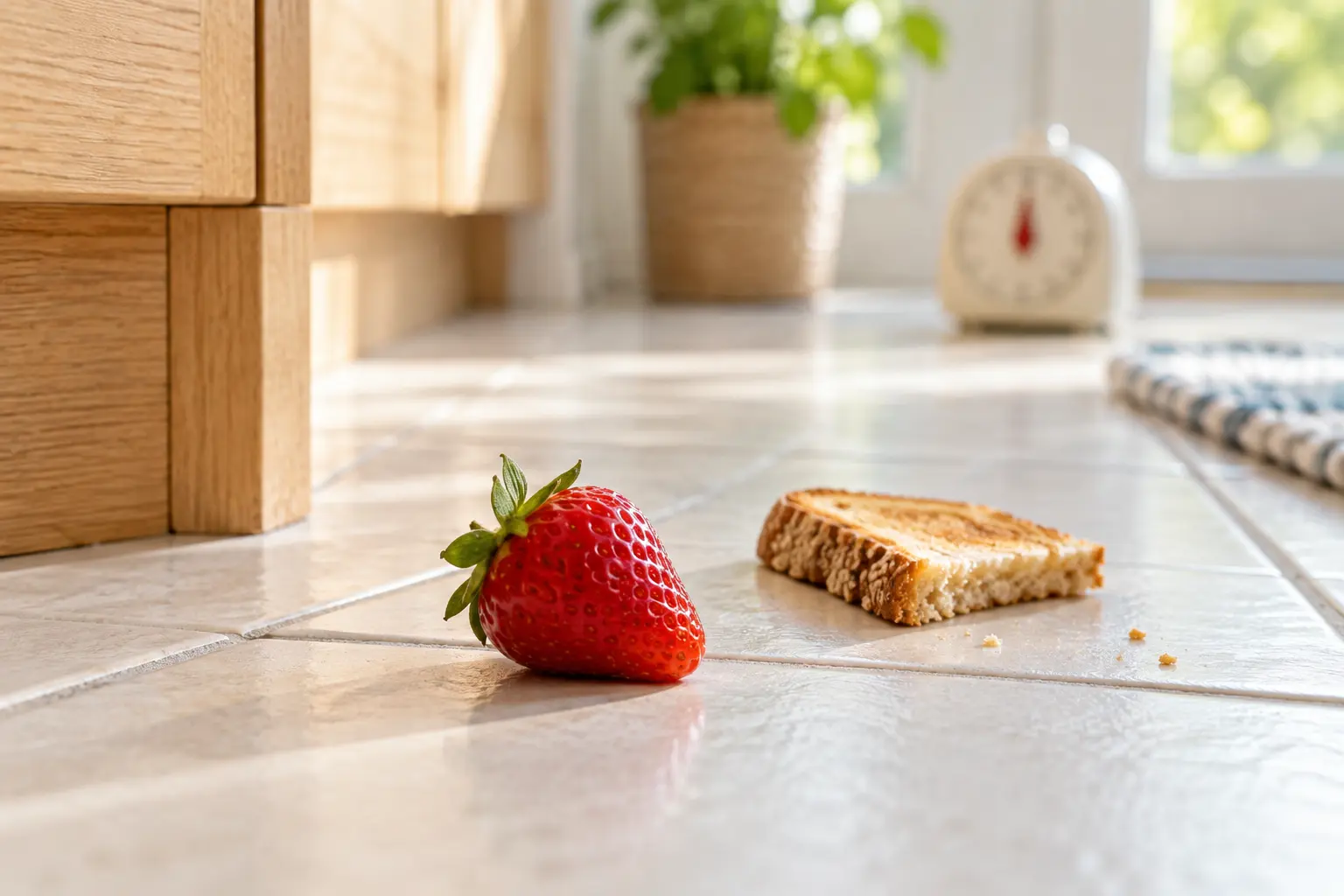
A dropped snack is not judged by a stopwatch alone. Moisture, surface, contact time and contamination all influence bacterial transfer, and some movement can happen in under a second.
The five-second rule sounds like a tiny contract with the kitchen floor: retrieve the snack before the count ends and the floor promises not to add anything. A stopwatch is wonderfully easy to understand. Bacterial transfer is not nearly so punctual.
A better way to examine a dropped bite is to picture four dials: the food, the surface, the contact time and what was on that surface to begin with. Laboratory studies can turn those dials one at a time. They cannot declare every real-world floor safe or unsafe, but they can show whether five seconds is a meaningful border.
In a 2016 study, Rutgers researchers tested four foods, four surfaces and four contact times. Watermelon, bread, buttered bread and gummy candy met stainless steel, ceramic tile, wood and carpet for less than one second, five seconds, 30 seconds or five minutes. The surfaces had been deliberately inoculated with Enterobacter aerogenes and allowed to dry, creating a controlled comparison rather than a copy of an ordinary kitchen.
The time dial did matter: longer contact generally allowed more transfer. The trouble for the rule is that transfer also occurred in some trials at less than one second. Five seconds was not a bacterial starting bell. It was simply one point along a process that could begin almost immediately.
The food dial produced an even clearer lesson. Watermelon collected the most bacteria overall, while gummy candy collected the least. Moisture helps explain much of that difference because a wet surface can create better contact between food and contamination. That does not make a dry sweet magically clean. It shows why a juicy strawberry and a crisp cracker are not equivalent experiments.
The landing place mattered too. Carpet often transferred less bacteria than tile or stainless steel in the Rutgers tests, but that result is not a cleanliness award for carpet. Fibres, flat surfaces and food shapes touch in different ways. A surface can transfer a smaller fraction in one setup and still be an unsuitable plate.
An earlier published study tested Salmonella Typhimurium on tile, wood and carpet with bread and a moist ready-to-eat food. Transfer could happen almost immediately, and the organism remained recoverable from dry tile for weeks under some laboratory conditions. Again, the researchers used controlled bacterial levels. The finding describes possibility and relative transfer, not the exact odds attached to a crumb on your floor.
That distinction matters because neither experiment followed someone after eating the test food. Actual illness risk also depends on whether a harmful organism is present, how much transfers, the food and the person eating it. A clean-looking floor cannot answer those questions, and neither can counting to five.
For a simple kitchen decision, use context instead of a countdown. Moist food, a visibly soiled area or a landing spot near shoes, pets or uncooked ingredients gives you more reason to discard the bite. A dry food on a recently cleaned surface may transfer less under some conditions, but lower is not the same as guaranteed safe.
Health Canada advises cleaning anything that comes into contact with food because cleaning helps remove bacteria and reduce food-related illness. That is excellent guidance for counters, utensils and hands. Floors still have a different job description. When dinner takes a dive, the scientifically honest rule is less catchy but more useful: the clock is only one of the crumbs in the story.
Sources
You may also like these